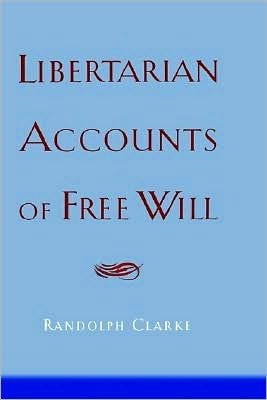
Libertarian Accounts of Free Will
0
0
As an Amazon Associate and affiliate partner, Menrva Books earns from qualifying purchases. Learn more
Author Description
This comprehensive study offers a balanced assessment of libertarian accounts of free will. Bringing to bear recent work on action, causation, and causal explanation, Clarke defends a type of event-causal view from popular objections concerning rationality and diminished control. He subtly explores the extent to which event-causal accounts can secure the things for the sake of which we value free will, judging their success here to be limited. Clarke then sets out a highly original agent-causal account, one that integrates agent causation and nondeterministic event causation. He defends this view from a number of objections but argues that we should find the substance causation required by any agent-causal account to be impossible. Clarke concludes that if a broad thesis of incompatibilism is correct--one on which both free will and moral responsibility are incompatible with determinism--then no libertarian account is entirely adequate.
Menrva's Summary
THE THESIS
This book investigates whether any libertarian account of free will can successfully reconcile human agency with the absence of determinism. Randolph K. Clarke, a scholar specializing in the philosophy of action, utilizes contemporary research on causation and causal explanation to evaluate existing theories. He constructs a rigorous framework to test whether event-causal and agent-causal models can adequately account for the conditions required for moral responsibility and rational control.
THE SCOPE MAP
What You Will Find
- A critical assessment of event-causal libertarianism and its limitations regarding control.
- An original proposal for an integrated agent-causal and nondeterministic event-causal model.
- A philosophical critique of substance causation as a requirement for agent-causal theories.
- An analysis of the broader implications of incompatibilism on the possibility of free will.
THE AUTHORITY PERSPECTIVE
Experts recognize this work as a significant contribution to the ongoing debate regarding the mechanics of human agency. Readers frequently note the technical density of the prose, which requires a strong background in analytic philosophy to fully navigate the author's arguments.
Page Count:
254
Publication Date:
2003-01-01
Publisher:
Oxford University Press
ISBN-10:
019803623X
ISBN-13:
9780198036234
Philosophy
Politics
Free Will
Categories
Kindle eBooks
Kindle Store
Metaphysics
Ethics
Community Tags
Similar Books