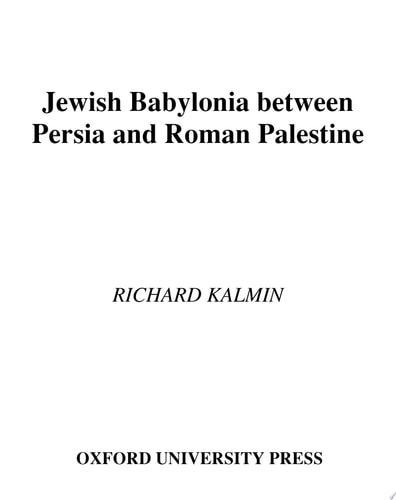
Jewish Babylonia between Persia and Roman Palestine: Decoding the Literary Record
0
0
As an Amazon Associate and affiliate partner, Menrva Books earns from qualifying purchases. Learn more
Author Description
The Babylonian Talmud was compiled in the third through sixth centuries CE, by rabbis living under Sasanian Persian rule in the area between the Tigris and Euphrates rivers. What kind of society did these rabbis inhabit? What effect did that society have on important rabbinic texts? In this book Richard Kalmin offers a thorough reexamination of rabbinic culture of late antique Babylonia. He shows how this culture was shaped in part by Persia on the one hand, and by Roman Palestine on the other. The mid fourth century CE in Jewish Babylonia was a period of particularly intense "Palestinianization," at the same time that the Mesopotamian and east Persian Christian communities were undergoing a period of intense "Syrianization." Kalmin argues that these closely related processes were accelerated by third-century Persian conquests deep into Roman territory, which resulted in the resettlement of thousands of Christian and Jewish inhabitants of the eastern Roman provinces in Persian Mesopotamia, eastern Syria, and western Persia, profoundly altering the cultural landscape for centuries to come. Kalmin also offers new interpretations of several fascinating rabbinic texts of late antiquity. He shows how they have often been misunderstood by historians who lack attentiveness to the role of anonymous editors in glossing or emending earlier texts and who insist on attributing these texts to sixth century editors rather than to storytellers and editors of earlier centuries who introduced changes into the texts they learned and transmitted. He also demonstrates how Babylonian rabbis interacted with the non-rabbinic Jewish world, often in the form of the incorporation of centuries-old non-rabbinic Jewish texts into the developing Talmud, rather than via the encounter with actual non-rabbinic Jews in the streets and marketplaces of Babylonia. Most of these texts were "domesticated" prior to their inclusion in the Babylonian Talmud, which was generally accomplished by means of th
Menrva's Summary
THE THESIS
How did the socio-political environment of Sasanian Persia and the influence of Roman Palestine shape the cultural and textual development of the Babylonian Talmud? Richard Kalmin, a scholar of late antique rabbinic culture, utilizes historical analysis and textual criticism to argue that the Babylonian rabbinic community was not an isolated entity. He demonstrates that the cultural landscape was profoundly altered by the movement of populations following Persian military conquests, which facilitated a cross-pollination of traditions between Mesopotamian, Syrian, and Palestinian Jewish and Christian communities.
THE SCOPE MAP
What You Will Find
- Analysis of the third through sixth centuries CE in Sasanian Babylonia.
- Examination of the process of 'Palestinianization' within rabbinic texts.
- Methodology for identifying the role of anonymous editors in the transmission of Talmudic narratives.
- Investigation into the incorporation of non-rabbinic Jewish texts into the Talmudic corpus.
THE AUTHORITY PERSPECTIVE
Scholars in the field of late antique Judaism recognize this work as a significant contribution to the understanding of rabbinic redaction and cultural history. Readers frequently note the academic density of the prose and the author's meticulous attention to the editorial layers within the Talmud.
Page Count:
285
Publication Date:
2006-01-01
Publisher:
Oxford University Press
ISBN-10:
0198041799
ISBN-13:
9780198041795
Religion
History
Bibles
Academic
Kindle eBooks
Judaism
Ancient History
Kindle Store
Categories
Community Tags
Similar Books