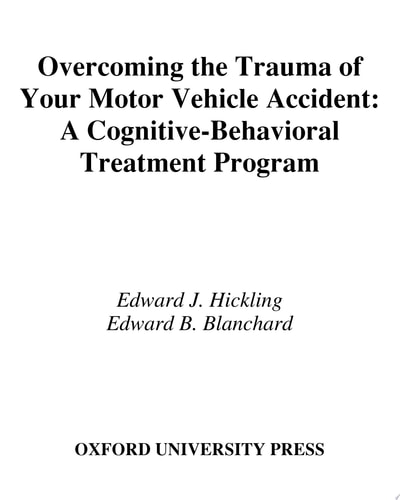
Overcoming the Trauma of Your Motor Vehicle Accident: Therapist Guide
0
0
As an Amazon Associate and affiliate partner, Menrva Books earns from qualifying purchases. Learn more
Author Description
It is estimated that over 3 million people per year are injured in motor vehicle accidents and up to 45% of people in a serious auto accident develop posttraumatic stress disorderl. Written by the creators of an empirically supported cognitive-behavioral therapy program developed at The Center for Stress and Anxiety Disorders in Albany, this therapist guide includes all the information and materials necessary to implement a successful program for treating accident-related PTSD. The therapeutic technique described in this book is research-based with a proven success rate. The renowned authors provide clinicians with step-by-step instructions for teaching their clients important skills that have been scientifically tested and shown to be effective in treating emotional trauma caused by involvement in a car accident. Designed to be used in conjunction with its corresponding workbook, this therapist guide outlines a treatment program that includes cognitive restructuring, relaxation techniques, and exposure exercises. User-friendly and comprehensive, Overcoming the Trauma of Your Motor Vehicle Accident, Therapist Guide is a resource that no clinician can do without.
Menrva's Summary
THE THESIS
This guide investigates the efficacy of a structured cognitive-behavioral therapy program in treating posttraumatic stress disorder resulting from motor vehicle accidents. The authors, Edward B. Blanchard and Edward J. Hickling, leverage their clinical experience at The Center for Stress and Anxiety Disorders to present a research-based framework. They argue that specific, empirically tested interventions can significantly reduce the psychological impact of vehicular trauma for patients. The text serves as a clinical manual designed to standardize the treatment process for mental health professionals.
THE SCOPE MAP
What You Will Find
- A comprehensive cognitive-behavioral therapy protocol specifically tailored for accident-related PTSD.
- Step-by-step instructions for implementing cognitive restructuring and relaxation techniques.
- Exposure exercise methodologies designed to mitigate trauma symptoms.
- Clinical materials and session guidelines for use alongside the patient workbook.
THE AUTHORITY PERSPECTIVE
Clinicians frequently cite this guide as a foundational resource for addressing the specific psychological sequelae of motor vehicle accidents. Experts highlight the text for its clear, evidence-based methodology and its utility in a professional therapeutic setting.
Page Count:
104
Publication Date:
2006-01-01
Publisher:
Oxford University Press
ISBN-10:
0198041764
ISBN-13:
9780198041764
Psychology
Categories
Kindle eBooks
Self Help
Trauma
Medical
Automotive
Nursing
Kindle Store
Mental Health
Community Tags
Similar Books