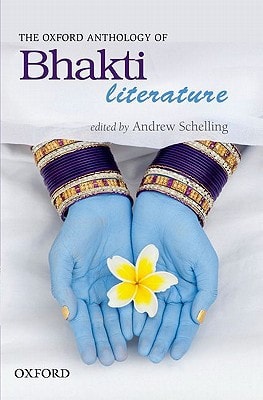
The Oxford Anthology of Bhakti Literature
0
0
As an Amazon Associate and affiliate partner, Menrva Books earns from qualifying purchases. Learn more
Author Description
Divided into four sections--North, South, East, and West--this anthology maps Bhakti literature from 100 BCE to the 20th century. Including a wide range of writings-from early poems to Siva, Alvar poets, Virashaiva poets, Varkaris, and Vaishnava poetry, to Panjabi songs, Bauls of Bengal, and Bengali Shakta lyrics-the anthology roughly sketches the four geographical compass points in terms of the significant sub-genres of Bhakti poetry associated with these regions. Apart from acclaimed poets such as Tukaram, Kabir, Mirabai, Tulsidas, Vidyapati, and Chandidas, the volume also includes works by some of the earliest practitioners like Tipputtolar (ca. 100 BCE-250 CE), Nakkirar (ca. 6th c.), and Mannikavacakar (9th c.). It also includes works of some later poets like Namdev (1270-1350), Rami (ca. 1440), and Dhurjati (16th c.) as well as more contemporary practitioners like Ramprasad Sen (1718-1775), Kamalakanta Bhattacarya (ca. 1769-1821), and Rabindranath Tagore (1861-1941). The poems, originally written in various vernacular lanaguges, have been translated by past masters like A.K. Ramanujan, as well as well-known practitioners like Vidya Dehejia, Susan Daniels, William J. Jackson, Dilip Chitre, Ananda Coomaraswamy, among others.With a detailed Introduction by Andrew Schelling, this volume has perceptive notes for poets and translators that provide valuable insights to their work. A special appendix Statements on Poetry adds special feature of this volume. With a glossary providing meaning to Sanskrit terms, and a bibliography, this volume gives a comprehensive view of the Bhakti movement.
Menrva's Summary
THE THESIS
This anthology investigates the historical and geographical breadth of the Bhakti movement by mapping its literary evolution from 100 BCE to the 20th century. Andrew Schelling, an established scholar and translator, compiles a vast array of vernacular poetry to argue that the Bhakti tradition functions as a diverse, multi-regional phenomenon rather than a singular religious expression. By organizing the material into four compass points—North, South, East, and West—the text provides a structured framework for understanding how devotional poetry adapted to local linguistic and cultural contexts over two millennia.
THE SCOPE MAP
What You Will Find
- A comprehensive collection of Bhakti poetry spanning from 100 BCE to the 20th century.
- Geographical categorization of literary sub-genres across North, South, East, and West India.
- Translations by notable scholars and poets including A.K. Ramanujan, Ananda Coomaraswamy, and Dilip Chitre.
- Supplemental scholarly apparatus including a glossary of Sanskrit terms, a bibliography, and an appendix titled Statements on Poetry.
THE AUTHORITY PERSPECTIVE
Experts and scholars of Indian literature frequently highlight this volume as a foundational resource for understanding the linguistic and regional diversity of the Bhakti movement. Readers often note the academic density of the prose and the high quality of the translations, which make it an essential reference for students of religious studies and comparative literature.
Page Count:
352
Publication Date:
2011-09-15
Publisher:
Oxford University Press
ISBN-10:
019806912X
ISBN-13:
9780198069126
Religion
Poetry
Spirituality
Bhakti
Asian Studies
Literary Criticism
Anthology
English literature
Community Tags
Similar Books