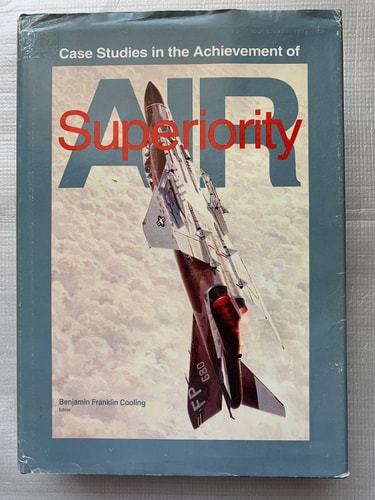
Case Studies in the Achievement of Air Superiority
0
0
As an Amazon Associate and affiliate partner, Menrva Books earns from qualifying purchases. Learn more
Author Description
Writing in 1978, General William W. Momyer, former Commander of the Tactical Air Command and a distinguished veteran fighter pilot, stated The contest for air superiority is the most important contest of all, for no other operations can be sustained if this battle is lost. To win it, we must have the best equipment, the best tactics, the freedom to use them, and the best pilots. Certainly, the wide-ranging case studies examined in this book confirm this message, as do more contemporary experiences from the Falklands War, the Bekaa Valley, and, most recently, the Gulf War of 1991. The historical roots of air superiority date to the First World War, which marked the emergence of the fighter airplane, offensive and defensive fighter doctrine, and the trained fighter pilot. By the end of the war, the Imperial German Air Service had been decisively outfought, and though occasional bitter air combat still occurred, the Allied air arms were free to harass and attack German ground forces wherever and whenever they chose. After the war, there were defense commentators who injudiciously predicted--not for the last time--that the era of dogfighting was over; higher aircraft speeds would make maneuvering air combat a thing of the past. Instead, the lesson of the importance of air superiority was rediscovered in the skies over Spain, and confirmed again throughout the Second World War. Having tenaciously wrested air superiority from the Luftwaffe, the Allies in 1941 went on to achieve genuine air supremacy, a situation acknowledged by General Dwight Eisenhower, who, riding through Normandy after D-Day, remarked to his "If I didn't have air supremacy, I wouldn't be here." Sadly, many of these lessons were lost in the post-Second World War era, when technology advances-supersonic design theory, nuclear weapons, and "robot" aircraft--seemed to signal an end to the traditional air-to-air fighter--even though the experience of the Korean War demonstrated that transonic jet combat was
Menrva's Summary
THE THESIS
This work investigates the critical necessity of achieving air superiority as a prerequisite for successful military operations across various theaters of conflict. Benjamin F. Cooling, a noted military historian, compiles a series of analytical case studies to demonstrate how air superiority dictates the outcome of ground and naval engagements. The text argues that despite technological shifts, the fundamental requirement for control of the skies remains a constant in modern warfare.
THE SCOPE MAP
What You Will Find
- Historical analysis of air combat from World War I through the Gulf War.
- Examination of fighter doctrine, including offensive and defensive strategies.
- Case studies covering the Spanish Civil War, World War II, and the Korean War.
- Evaluation of the impact of supersonic design and nuclear-era technology on air combat.
Scope Limits
- The text does not provide a comprehensive technical manual for modern avionics or current stealth technology.
- It focuses primarily on the strategic and doctrinal evolution of air superiority rather than individual pilot biographies.
THE AUTHORITY PERSPECTIVE
Experts frequently cite this collection as a foundational text for understanding the historical evolution of air combat doctrine. Readers often note the academic density of the prose, which serves as a rigorous resource for military students and historians alike.
Page Count:
678
Publication Date:
1994-06-01
Publisher:
For sale by the Supt. of Docs., U.S. G.P.O
ISBN-10:
0160022681
ISBN-13:
9780160022685
History
Strategy
Tactics
Air warfare
Aviation
Military
Military History
Community Tags
Similar Books






Reader Comments
Share Your Thoughts
No comments yet. Be the first to share your thoughts!