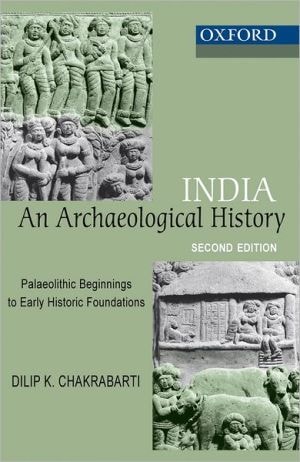
India: An Archaeological History: Palaeolithic Beginnings to Early Historic Foundations
0
0
As an Amazon Associate and affiliate partner, Menrva Books earns from qualifying purchases. Learn more
Author Description
An increased pace in archaeological research in recent decades has yielded a construction of the history of prehistoric and early historic India primarily in terms of archaeology. This book charts the flow of India's grassroots archaeological history in all its continuities and diversities from its Palaeolithic beginnings to AD 300 when early historic India assumed its basic form.The book reconstructs the historical development of human-natural resource interaction in the subcontinent in a lucid style with maps, illustrations, and tables. This second edition contains a new afterword, which discusses all new ideas and discoveries in Indian Archaeology between 1998 and 2008. Written by an expert on Indian archaeology, this book would be indispensable for students and specialists of archaeology and early South Asian history.
Menrva's Summary
THE THESIS
This work investigates the historical development of human-natural resource interaction in the Indian subcontinent from the Palaeolithic era through the early historic period. Dilip K. Chakrabarti, a recognized expert in the field, synthesizes decades of archaeological research to construct a comprehensive history of India's early foundations. By analyzing material evidence and environmental contexts, the author provides a framework for understanding how early societies evolved and established their basic forms by AD 300.
THE SCOPE MAP
What You Will Find
- Chronological coverage from the Palaeolithic period to the early historic foundations around AD 300.
- Analysis of human-natural resource interaction and settlement patterns across the subcontinent.
- Integration of maps, illustrations, and data tables to support archaeological findings.
- A dedicated afterword detailing significant discoveries and theoretical shifts in Indian archaeology between 1998 and 2008.
THE AUTHORITY PERSPECTIVE
Experts and academics regard this text as a foundational resource for understanding the archaeological trajectory of South Asia. Readers frequently note the scholarly density of the prose, which serves as a primary reference for students and specialists in the field of early Indian history.
Page Count:
416
Publication Date:
2010-02-08
Publisher:
Oxford University Press
ISBN-10:
0198064128
ISBN-13:
9780198064121
History
Archaeology
Prehistoric History
Anthropology
India
Community Tags
Other Editions(3)
Similar Books