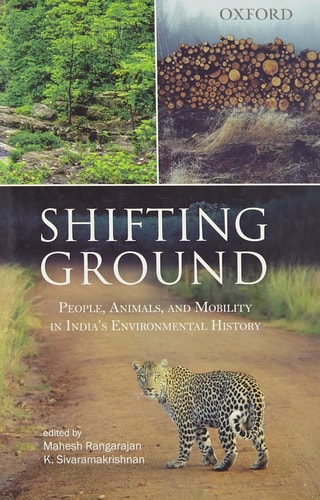
Shifting Ground: People, Mobility and Animals in India's Environmental Histories
0
0
As an Amazon Associate and affiliate partner, Menrva Books earns from qualifying purchases. Learn more
Author Description
Environmental history of India has developed as an important field of inquiry in the last twenty-five years. While providing major insights, the existing scholarship has primarily focused on drawing sharp lines of distinction-those between geographical spaces (forest, rivers, farms), people (herders, farmers, townspeople), eras (colonial, post-colonial), and so on. The limitations of these sharp divides are brought to the forefront when there is a critical engagement with the region's contested environmental past.Shifting Ground brings together an array of essays that pose critical questions regarding India's environmental past and the way it has been approached by scholars. From debunking the idea of a primeval, pristine forest cover, to analysing the dynamics that shape human-animal relations, to examining the conflicts created by post-Independence projects of rural development and conservation-this volume touches upon the various aspects of environmental studies and juxtaposes them with social history, history of science and technology, and history of trade and culture.Drawing on original case studies the book not only explores the past, but also portrays how its traditions are often invoked to be deployed in contemporary conflicts-those that are often aggravated by the pressures on natural assets created by the recent prosperity and the vaulting aspirations of a rapidly expanding Indian middle class.
Menrva's Summary
THE THESIS
This volume investigates the limitations of traditional, compartmentalized approaches to Indian environmental history by challenging the rigid distinctions between geographical spaces, human populations, and historical eras. The authors, K. Sivaramakrishnan and Mahesh Rangarajan, curate a collection of essays that synthesize social history, the history of science, and cultural studies to re-examine the region's contested environmental past. By moving beyond binary classifications, the text provides a framework for understanding how historical traditions are actively invoked to navigate contemporary conflicts over natural resources and development.
THE SCOPE MAP
What You Will Find
- Analysis of human-animal relations and their evolution over time.
- Critical evaluation of post-Independence rural development and conservation projects.
- Case studies debunking the myth of pristine, primeval forest cover in India.
- Examination of how historical narratives are deployed in modern debates regarding middle-class prosperity and resource pressure.
THE AUTHORITY PERSPECTIVE
Scholars and historians recognize this collection as a significant intervention in the field of South Asian environmental studies. Readers frequently note that the text successfully bridges the gap between specialized academic research and broader socio-political history.
Page Count:
308
Publication Date:
2014-12-01
Publisher:
Oxford University Press
ISBN-10:
0198098952
ISBN-13:
9780198098959
Nature
History
India
Nature
Human ecology
Social Science
Community Tags
Similar Books