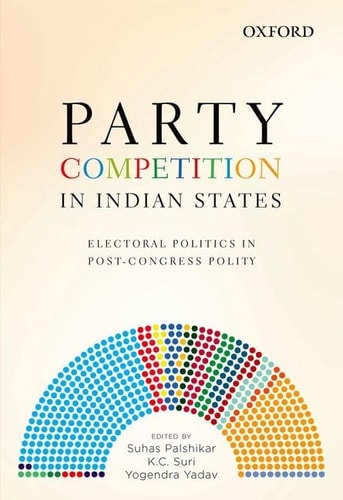
Party Competition in Indian States: Electoral Politics in Post-Congress Polity
0
0
As an Amazon Associate and affiliate partner, Menrva Books earns from qualifying purchases. Learn more
Author Description
Ever since the Congress system finally collapsed and the post-Congress polity emerged in 1989, state has arisen as the most crucial terrain at which electoral outcomes are shaped. This book presents analyses of electoral politics in 24 states of India during the period 2008-2013. This period is of great interest because in the post-2004 period, Congress started adapting itself to the compulsions of the post-Congress polity and survive as one of the competitors in electoral politics. In a sense, the period under study here is the period of a stable post-Congress polity. Apart from the parliamentary election of 2009 that brought the Congress-led UPA back to power with an increased strength of the Congress party, this period also witnessed assembly elections in each of the states discussed here. The chapters look both at the Parliamentary election of 2009 and the Assembly election from each state to investigate how the two impact each other and what broader patterns emerge from their interaction. While the all-India picture of competitive politics presented the picture of routineness of electoral competition, many states threw up characteristics of a much more fluid competitive politics. This volume brings out this complex pattern of electoral politics at the state level and seeks to contribute to our understanding of state level political processes by using the rich data set of post-election surveys done by the Centre for the Study of Developing Societies, New Delhi over the years.
Menrva's Summary
THE THESIS
This book investigates the transformation of electoral competition in India following the decline of the Congress system and the emergence of a stable post-Congress polity. The authors, prominent political scientists associated with the Centre for the Study of Developing Societies, utilize extensive post-election survey data to analyze how state-level political dynamics have become the primary drivers of national electoral outcomes. By examining the interplay between the 2009 parliamentary elections and concurrent state assembly elections, the work provides a framework for understanding the fluidity and regional variations inherent in contemporary Indian democracy.
THE SCOPE MAP
What You Will Find
- Comparative analysis of electoral politics across 24 Indian states between 2008 and 2013.
- Examination of the interaction between parliamentary and assembly election cycles.
- Empirical evidence derived from large-scale post-election survey datasets.
- Assessment of the Congress party's adaptation strategies within a multi-party competitive landscape.
THE AUTHORITY PERSPECTIVE
Experts recognize this volume as a significant contribution to the study of Indian federalism and electoral behavior. Scholars frequently cite the work for its rigorous use of survey data to map the complexities of state-level political processes.
Page Count:
600
Publication Date:
2014-07-15
Publisher:
Oxford University Press
ISBN-10:
0198099177
ISBN-13:
9780198099178
Politics
Elections
Government
India
Community Tags
Similar Books