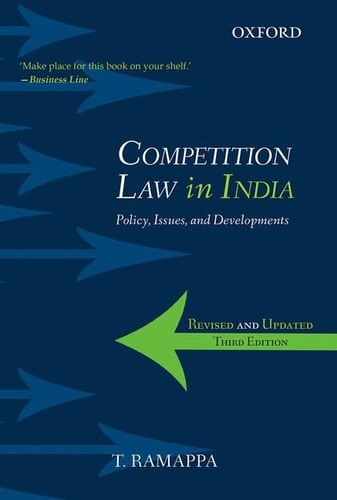
Competition Law in India: Policy, Issues, and Developments
0
0
As an Amazon Associate and affiliate partner, Menrva Books earns from qualifying purchases. Learn more
Author Description
India, till 2002, did not have a law dealing specifically with anti-trust issues. It was in this context that a separate law dealing with competition and antitrust issues was considered necessary and the Competition Act, 2002, was passed. Enacted to fulfil India's obligations under the WTO agreements, the Act replaced the then existing Monopolies and Restrictive Trade Practices Act, 1969 (MRTP Act) which was considered inadequate and archaic for the purpose of meeting the objectives of competition policy.This substantially revised edition discusses the Competition Act, 2002, and subsequent amendments to it, in 2007 and 2009. Following the 2007 amendment, the Competition Commission became a market regulator and the Competition Appellate Tribunal was established. The 2009 amendment provided for a mechanism to dispose of the cases pending before the MRTP Commission. The book makes a detailed study of key issues including anti-competitive agreements, abuse of dominant position, and combinations (acquisitions and mergers). It further analyses the roles of authorities such as the Competition Commission of India, the Director-General, and the Competition Appellate Tribunal in enforcing the provisions of the Act. The book also undertakes a comparative study of competition law in the US, UK, and EU with emphasis on important judgments.
Menrva's Summary
THE THESIS
This book investigates the evolution and implementation of competition law in India following the transition from the Monopolies and Restrictive Trade Practices Act to the Competition Act of 2002. T. Ramappa provides a comprehensive examination of the regulatory framework governing anti-trust issues in the Indian market. The text utilizes legislative history, statutory analysis, and comparative legal studies to explain how India aligns its domestic trade policies with international WTO obligations. By detailing the roles of the Competition Commission and the Appellate Tribunal, the author establishes a clear understanding of the current enforcement mechanisms.
THE SCOPE MAP
What You Will Find
- Analysis of the Competition Act 2002 and its subsequent 2007 and 2009 amendments.
- Detailed examination of anti-competitive agreements, abuse of dominant market position, and corporate combinations.
- Comparative legal studies of competition frameworks in the US, UK, and EU.
- Evaluation of the enforcement roles held by the Competition Commission of India and the Director-General.
THE AUTHORITY PERSPECTIVE
Legal scholars and practitioners recognize this work as a foundational text for understanding the transition of Indian antitrust regulation. Readers frequently note the technical clarity of the prose, which makes complex legislative amendments accessible to both students and professionals in the field.
Page Count:
384
Publication Date:
2014-02-01
Publisher:
Oxford University Press
ISBN-10:
0198097271
ISBN-13:
9780198097273
Economics
Business
Law india
Antitrust Law
Law
Public Policy
India
Community Tags
Similar Books