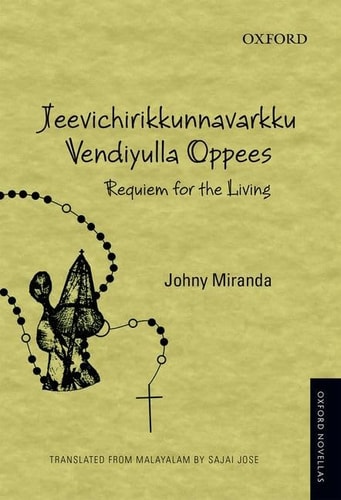
Jeevichirikkunnavarkku Vendiyulla Oppees: Requiem for the Living
0
0
As an Amazon Associate and affiliate partner, Menrva Books earns from qualifying purchases. Learn more
Author Description
Johny Miranda's Jeevichirikkunavarkku Vendiyulla Oppees is an extraordinary work of literature which promises to be a critical event in contemporary Malayalam. I deliberately evoke the future tense here--for the work, though published for a while in Malayalam, is yet to be discovered fully even in Kerala. It will indeed be an interesting event, too, in the history of translation from Indian languages into English, when a truly remarkable work of writing, mostly undiscovered in the former, is elevated to the attention it deserves through a translation. The novella presents an extremely complex and intriguing tale of the community's slow merging into the bosom of the Catholic Church through the eyes of a male member-whose most striking feature is precisely his emasculation and powerlessness. And precisely because of this, the story of this merging is presented as a dirge at its impending disappearance. But such masculinity is presented with remarkable irony-and hence this is no simple narrative of masculine angst. The pathos of fatherlessness-the other side of which is the extraordinary centrality of the mothers-emerges again and again as the central axis of the crisis, which frames the turning-point in the narrative. This is when the protagonist, a grave-digger by profession, discovers a small golden key from the cemetery, which sends him on an anguished journey in search of its lock. This masterful metaphor indicates in no uncertain terms that the novella is about an identity-for identities, especially community identities, arelike keys for which locks have to be found. This anguish reaches a crescendo when the novella ends, when the protagonist
Menrva's Summary
THE PULSE
A grave-digger’s discovery of a mysterious golden key triggers a profound existential crisis regarding his community’s fading identity. The protagonist, a man defined by his perceived powerlessness and emasculation, navigates the shifting landscape of his community as it is absorbed into the Catholic Church. His search for the lock that fits his discovered key serves as the primary catalyst for the narrative, forcing him to confront the absence of paternal figures and the overwhelming influence of maternal authority. The story unfolds as a melancholic reflection on cultural erasure, utilizing the protagonist’s internal struggle to mirror the broader societal transition.
INSIDE THE PAGES
- Exploration of the intersection between religious assimilation and cultural identity.
- Use of the grave-digger as a symbolic figure representing the intersection of life and death.
- Examination of the psychological impact of fatherlessness within a specific community structure.
- Deployment of irony to subvert traditional tropes of masculine angst.
- Focus on the central role of maternal figures as the axis of social stability.
- Metaphorical narrative structure where the search for a lock represents the search for self-definition.
- Atmospheric prose that functions as a dirge for a disappearing way of life.
- Non-linear thematic progression that emphasizes the weight of historical and communal memory.
THE COLLECTIVE ECHO
Critics and readers frequently highlight the novella as a significant, yet under-recognized, contribution to contemporary Malayalam literature. Discussion often centers on the author's use of irony to navigate complex themes of masculinity and religious integration. The narrative is noted for its dense, metaphorical quality, which elevates a personal story into a broader commentary on communal identity. Readers frequently observe that the pacing is deliberate and reflective, prioritizing character introspection over traditional plot progression. The work is widely regarded as a challenging and evocative piece that rewards careful engagement with its symbolic layers.
Page Count:
128
Publication Date:
2014-02-02
Publisher:
Oxford University Press
ISBN-10:
0198097468
ISBN-13:
9780198097464
Literary Fiction
Fiction
Indian
Novella
Community Tags
Similar Books