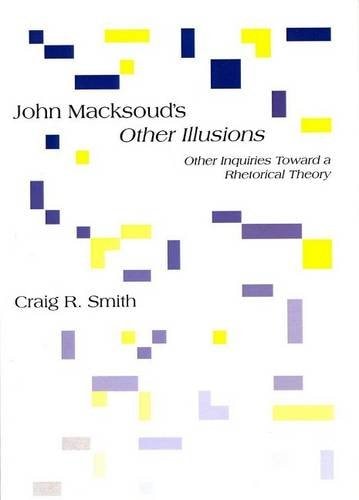
John Macksoud's Other Illusions
0
0
As an Amazon Associate and affiliate partner, Menrva Books earns from qualifying purchases. Learn more
Author Description
Craig Smith has provided an introduction and edition of John Macksoud's Other Illusions. This posthumous work, completed in 1973, reinforces a strain of relativistic theory that retrieves the Sophists and extends through Jacques Derrida to the present where many of us deal with constructed realities in our rhetorical theories. Macksoud was also offering a warning about pseudo-scientific research, a Philipic against the quantitative approach to communication theory. He not only attempted to reveal the rhetorical nature of their use of the scientific method, he tried to show that science itself was at base rhetorical. In form, the short book threatened the established order of the academic community. The book uses anecdotes, sayings, stories, and even jokes to mark off sections and to initiate new lines of thought. These devices were deemed subversive rather than performative because they are rarely, if ever, used in academic prose and because the messages they carry undercut normal ways of thinking.
Menrva's Summary
THE THESIS
This book investigates the rhetorical nature of scientific inquiry and the constructed realities within communication theory, challenging the dominance of quantitative approaches. Craig Smith, a scholar in the field, provides an introduction and edition of John Macksoud's posthumous work, originally completed in 1973. Macksoud's text, drawing on relativistic theory from the Sophists through Jacques Derrida, argues that science itself is fundamentally rhetorical and warns against pseudo-scientific research in communication. The book's unconventional structure, employing anecdotes, sayings, stories, and jokes, was considered subversive by the academic community for its departure from standard prose and its tendency to disrupt conventional thought patterns.
THE SCOPE MAP
- An exploration of relativistic theory and its connection to Sophists and Jacques Derrida.
- A critique of the quantitative approach in communication theory and pseudo-scientific research.
- An examination of science as a rhetorical practice.
- Analysis of Macksoud's posthumous work, completed in 1973.
- Discussion of the subversive use of anecdotes, sayings, stories, and jokes in academic discourse.
THE AUTHORITY PERSPECTIVE
The book's structure, which deviates from typical academic prose by incorporating anecdotes, sayings, stories, and jokes, was perceived as subversive by the academic community. This approach was intended to reveal the rhetorical underpinnings of the scientific method and to question the very nature of science as a rhetorical construct. The work challenges established academic norms and offers a critique of quantitative methodologies in communication theory.
Page Count:
295
Publication Date:
2009-09-15
Publisher:
Purdue University Press
ISBN-10:
1557535159
ISBN-13:
9781557535153
Non-Fiction
Philosophy
Postmodernism
Communication Theory
Rhetoric
Community Tags
Similar Books