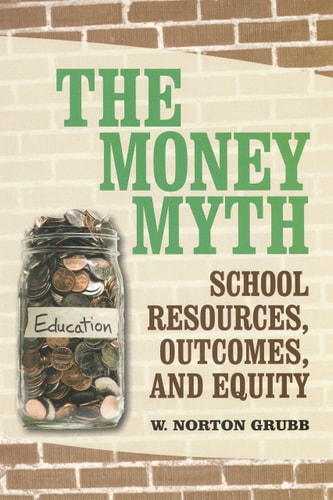
The Money Myth: School Resources, Outcomes, and Equity
0
0
As an Amazon Associate and affiliate partner, Menrva Books earns from qualifying purchases. Learn more
Author Description
Can money buy high-quality education? Studies find only a weak relationship between public school funding and educational outcomes. In The Money Myth, W. Norton Grubb proposes a powerful paradigm shift in the way we think about why some schools thrive and others fail. The greatest inequalities in America's schools lie in factors other than fiscal support. Fundamental differences in resources other than money—for example, in leadership, instruction, and tracking policies—explain the deepening divide in the success of our nation's schoolchildren. The Money Myth establishes several principles for a bold new approach to education reform. Drawing on a national longitudinal dataset collected over twelve years, Grubb makes a crucial distinction between "simple" resources and those "compound," "complex," and "abstract" resources that cannot be readily bought. Money can buy simple resources—such as higher teacher salaries and smaller class sizes—but these resources are actually some of the weakest predictors of educational outcomes. On the other hand, complex resources pertaining to school practices are astonishingly strong predictors of success. Grubb finds that tracking policies have the most profound and consistent impact on student outcomes over time. Schools often relegate low-performing students—particularly minorities—to vocational, remedial, and special education tracks. So even in well-funded schools, resources may never reach the students who need them most. Grubb also finds that innovation in the classroom has a critical impact on student success. Here, too, America's schools are stratified. Teachers in underperforming schools tend to devote significant amounts of time to administration and discipline, while instructors in highly ranked schools dedicate the bulk of their time to "engaged learning," using varied pedagogical approaches. Effective schools distribute leadership among many instructors and administrators, and they foster a sense of both trust and accoun
Menrva's Summary
THE THESIS
This book challenges the conventional understanding of the relationship between school funding and educational outcomes. W. Norton Grubb argues that the primary drivers of educational inequality are not financial, but rather stem from differences in non-monetary resources such as leadership, instructional practices, and tracking policies. By distinguishing between easily purchased 'simple' resources and more complex, practice-based resources, Grubb posits that the latter are far more influential in determining student success. The book draws on a twelve-year longitudinal dataset to support its claims, highlighting how tracking systems and the nature of classroom innovation significantly impact educational equity.
THE SCOPE MAP
- Analysis of the weak correlation between public school funding and educational outcomes.
- Introduction of a paradigm shift in understanding school success and failure.
- Distinction between 'simple' resources (e.g., teacher salaries, class size) and 'compound,' 'complex,' and 'abstract' resources.
- Identification of leadership, instruction, and tracking policies as key non-fiscal determinants of educational equity.
- Examination of the profound and consistent impact of tracking policies on student outcomes, particularly for minority students.
- Analysis of how 'engaged learning' and pedagogical approaches in high-achieving schools contrast with administrative and disciplinary focus in underperforming schools.
- Discussion of distributed leadership and the fostering of trust and accountability within effective schools.
- Utilization of a national longitudinal dataset collected over twelve years.
THE AUTHORITY PERSPECTIVE
The Money Myth proposes a significant re-evaluation of educational reform by shifting focus from financial inputs to the qualitative aspects of school practices. Grubb's analysis, grounded in extensive longitudinal data, suggests that factors like leadership quality, instructional methods, and student tracking systems are more critical predictors of student success than monetary investment alone. The book establishes principles for a new approach to education reform, emphasizing that true equity lies in the effective distribution and utilization of complex, non-monetary resources.
Page Count:
416
Publication Date:
2011-01-01
Publisher:
Russell Sage Foundation
ISBN-10:
0871540436
ISBN-13:
9780871540430
Politics
Non-Fiction
Economics
Policy
Sociology
Education
Community Tags
Similar Books