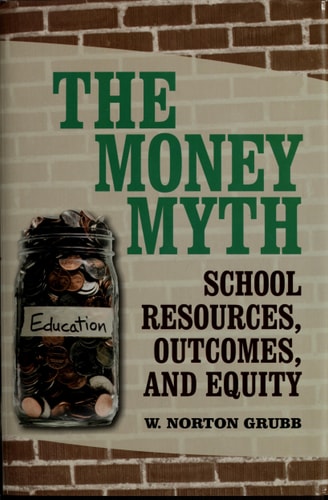
The Money Myth: School Resources, Outcomes, and Equity
0
0
As an Amazon Associate and affiliate partner, Menrva Books earns from qualifying purchases. Learn more
Author Description
Can money buy high-quality education? Studies find only a weak relationship between public school funding and educational outcomes. In The Money Myth, W. Norton Grubb proposes a powerful paradigm shift in the way we think about why some schools thrive and others fail. The greatest inequalities in America's schools lie in factors other than fiscal support. Fundamental differences in resources other than money―for example, in leadership, instruction, and tracking policies―explain the deepening divide in the success of our nation's schoolchildren. The Money Myth establishes several principles for a bold new approach to education reform. Drawing on a national longitudinal dataset collected over twelve years, Grubb makes a crucial distinction between "simple" resources and those "compound," "complex," and "abstract" resources that cannot be readily bought. Money can buy simple resources―such as higher teacher salaries and smaller class sizes―but these resources are actually some of the weakest predictors of educational outcomes. On the other hand, complex resources pertaining to school practices are astonishingly strong predictors of success. Grubb finds that tracking policies have the most profound and consistent impact on student outcomes over time. Schools often relegate low-performing students―particularly minorities―to vocational, remedial, and special education tracks. So even in well-funded schools, resources may never reach the students who need them most. Grubb also finds that innovation in the classroom has a critical impact on student success. Here, too, America's schools are stratified. Teachers in underperforming schools tend to devote significant amounts of time to administration and discipline, while instructors in highly ranked schools dedicate the bulk of their time to "engaged learning," using varied pedagogical approaches. Effective schools distribute leadership among many instructors and administrators, and they foster a sense of both trust and accoun
Menrva's Summary
THE THESIS
This book challenges the conventional wisdom that increased school funding directly translates to improved educational outcomes and equity. W. Norton Grubb, drawing on a twelve-year longitudinal dataset, argues that the most significant disparities in American schools stem from non-monetary resources such as leadership, instructional practices, and tracking policies. He distinguishes between easily purchased
THE SCOPE MAP
- Analysis of a national longitudinal dataset collected over twelve years.
- Distinction between "simple" resources (e.g., teacher salaries, class size) and "compound," "complex," and "abstract" resources.
- Examination of the impact of tracking policies on student outcomes, particularly for minority students.
- Investigation into the role of classroom innovation and pedagogical approaches.
- Exploration of distributed leadership and the fostering of trust and accountability within schools.
THE AUTHORITY PERSPECTIVE
W. Norton Grubb's "The Money Myth" presents a significant re-evaluation of the relationship between school funding and educational success. The book's argument, grounded in extensive data, suggests that focusing solely on financial investment overlooks critical non-monetary factors that drive educational inequality. Grubb's analysis of tracking policies and instructional practices offers a framework for understanding why some schools achieve better outcomes than others, even with similar funding levels. This work is positioned to influence discussions on education reform by shifting the focus towards systemic and structural issues within schools.
Page Count:
416
Publication Date:
2009-01-15
Publisher:
Russell Sage Foundation
ISBN-10:
0871543664
ISBN-13:
9780871543660
Non-Fiction
Economics
Politics
Sociology
Education
Policy
Community Tags
Similar Books