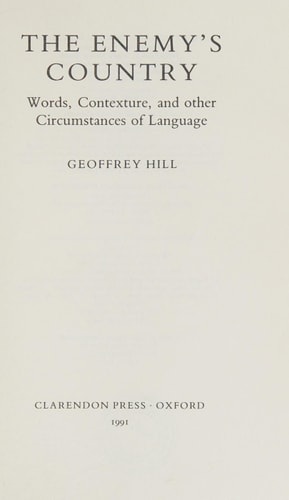
The Enemy's Country: Words, Contexture, and Other Circumstances of Language
0
0
As an Amazon Associate and affiliate partner, Menrva Books earns from qualifying purchases. Learn more
Author Description
Poetry has sometimes been credited with a special place as a form of conduct in language, as if it were a world of words of its own from which the poet masterfully dispenses a distinctly free speech. These essays enquire whether such high praises, even when sincere, are apt to the real conditions of poets' work, to their share of drudgery, their fears of misapprehension or their need to please, to the entanglements of meaning in historical communities.
Menrva's Summary
THE THESIS
This collection of essays investigates the tension between the idealized perception of poetry as a realm of absolute linguistic freedom and the pragmatic, often constrained reality of the poet's labor. Geoffrey Hill, a distinguished poet and academic, examines the intersection of creative expression and the historical, social, and political contexts that shape language. He argues that poets operate within a complex web of obligations, anxieties, and communal meanings rather than in a vacuum of pure artistic autonomy.
THE SCOPE MAP
What You Will Find
- Critical analysis of the relationship between poetic intent and linguistic reception
- Examination of the historical and social pressures that influence the act of writing
- Theoretical discourse on the nature of 'free speech' within the constraints of poetic form
- Reflections on the drudgery and technical challenges inherent in the craft of poetry
THE AUTHORITY PERSPECTIVE
Scholars and critics frequently note the dense, rigorous, and highly intellectual nature of Hill's prose in this collection. It is widely regarded as a foundational text for those interested in the intersection of linguistic philosophy and the practical realities of poetic composition.
Page Count:
168
Publication Date:
2001-07-03
Publisher:
OUP Oxford
ISBN-10:
0198112165
ISBN-13:
9780198112167
Poetry
Non-Fiction
Language
Literary Criticism
Poetry
Essays
Community Tags
Similar Books