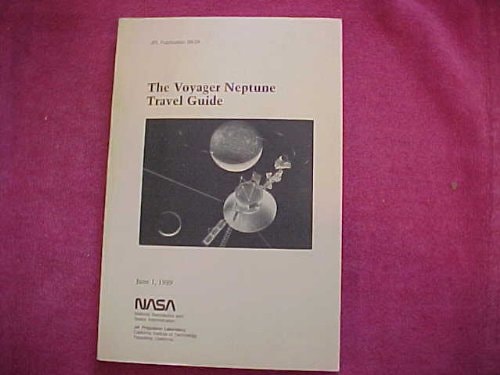
Voyager Neptune Travel Guide
0
0
As an Amazon Associate and affiliate partner, Menrva Books earns from qualifying purchases. Learn more
Author Description
This description is from NASA: The Voyager mission to the giant outer planets of our solar system is described. Scientific highlights include interplanetary cruise, Jupiter, Saturn, Uranus, and their vast satellite and ring systems. Detailed plans are provided for the August 1989 Neptune encounter and subsequent interstellar journey to reach the heliopause. As background, the elements of an unmanned space mission are explained, with emphasis on the capabilities of the spacecraft and the scientific sensors. Other topics include the Voyager Grand Tour trajectory design, deep-space navigation, and gravity-assist concepts. The Neptune flyby is animated through the use of computer-generated, flip-page movie frames that appear in the corners of the publication. Useful historical information is also presented, including facts associated with the Voyager mission. Finally, short summaries are provided to describe the major objectives and schedules for several space missions planned for the remainder of the 20th century.
Menrva's Summary
THE THESIS
This publication documents the technical objectives, scientific instrumentation, and mission trajectory of the Voyager spacecraft as it approaches the Neptune encounter. The text serves as an official NASA overview, detailing the engineering constraints of unmanned deep-space exploration and the specific scientific goals established for the outer planet flybys. It provides a comprehensive look at the mechanics of gravity-assist maneuvers and the navigation required to reach the heliopause.
THE SCOPE MAP
What You Will Find
- Technical specifications of Voyager spacecraft sensors and communication systems
- Analysis of the Grand Tour trajectory design and gravity-assist physics
- Historical data regarding the Jupiter, Saturn, and Uranus encounters
- Animated flip-page sequences illustrating the Neptune flyby mechanics
Scope Limits
- Does not provide post-1989 mission data or long-term heliopause findings
- Excludes detailed biological or speculative exoplanetary research
THE AUTHORITY PERSPECTIVE
Experts recognize this document as a primary historical record of the Voyager mission's planning phase. Readers frequently note the technical clarity of the prose, which makes complex orbital mechanics accessible to a general audience interested in space history.
Page Count:
276
Publication Date:
1989-01-01
Publisher:
United States Government Printing
ISBN-10:
0160042623
ISBN-13:
9780160042621
Science
Travel
Astronomy
Reference
Science History
Community Tags
Similar Books