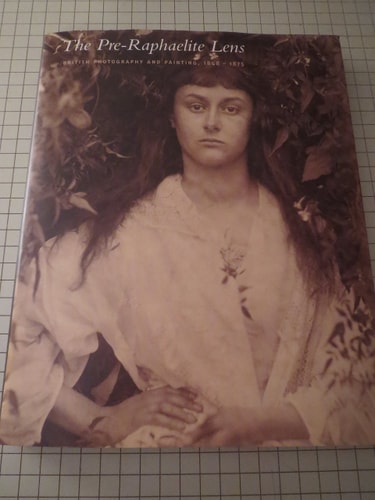
The Pre-Raphaelite Lens: British Photography and Painting, 1848-1875
0
0
As an Amazon Associate and affiliate partner, Menrva Books earns from qualifying purchases. Learn more
Author Description
Every movement has its genesis, as every flower its seed; the seed of the flower of Pre-Raphaeli[ti]sm was photography. ---William Bell Scott As photography steadily gained a foothold in the 1840S, a group of British painters calling themselves the Pre-Raphaelites came of age. Answering John Ruskin's call to study nature, "rejecting nothing, selecting nothing, and scorning nothing," these young painters were also spurred on by the possibilities of the new medium (introduced in 1839), particularly its ability to capture every nuance, every detail. And yet, the Pre-Raphaelites' debt to photography has barely been acknowledged. From photography, painters learned to see anew: adapting such radical qualities as abrupt cropping, planar recession, and a lack of modulation between forms, painters made their art modern, sometimes shockingly so. Photographers in turn looked to Pre-Raphaelite visual strategies and subject matter---mined from literature, history, religion---"to secure," as Julia Margaret Cameron wrote, "the character and uses of High Art." These artists developed a shared vocabulary---featuring light and minute detail as an emblem of visual truth---which helped launch realism as the century's dominant visual mode. "Exactness," a critic affirmed in 1856, "is the tendency of the age." This volume explores the rich dialogue between photography and painting through the themes of landscape, portraiture, literary and historical narratives, and modern-life subjects. These artists---from photographers Lewis Carroll, Julia Margaret Cameron, Roger Fenton, Henry Peach Robinson, and Oscar Gustave Rejlander, to such painters as John Everett Millais, William Holman Hunt, Dante Gabriel Rossetti, and John William Inchbold---not only had much in common, but also upended traditional approaches to making pictures.
Menrva's Summary
THE THESIS
This volume investigates the profound and often overlooked reciprocal relationship between early British photography and Pre-Raphaelite painting during a pivotal period of artistic innovation from 1848 to 1875. The book explores how the nascent medium of photography influenced painters' perceptions of composition, detail, and realism, while photographers, in turn, adopted Pre-Raphaelite visual strategies and thematic concerns to elevate their medium to the status of 'High Art.' It posits that this dynamic exchange was instrumental in the rise of realism as the dominant visual mode of the Victorian era.
THE SCOPE MAP
- An examination of the genesis of Pre-Raphaelitism and its connection to the emergence of photography.
- Analysis of how photographic techniques like abrupt cropping and planar recession influenced Pre-Raphaelite painters.
- Exploration of how photographers like Julia Margaret Cameron and Oscar Gustave Rejlander drew inspiration from Pre-Raphaelite visual strategies and subject matter.
- Discussion of shared visual vocabularies, particularly the use of light and minute detail as emblems of visual truth.
- Thematic sections covering landscape, portraiture, literary and historical narratives, and modern-life subjects.
- Case studies of key artists including Lewis Carroll, Roger Fenton, Henry Peach Robinson, John Everett Millais, William Holman Hunt, Dante Gabriel Rossetti, and John William Inchbold.
THE AUTHORITY PERSPECTIVE
The book explores the rich dialogue between photography and painting, highlighting how painters adapted radical photographic qualities and how photographers sought to achieve 'High Art' status by emulating Pre-Raphaelite visual strategies. The volume examines shared artistic vocabularies, particularly the emphasis on light and detail as indicators of visual truth, which contributed to the rise of realism. It features contributions from notable art historians and curators, offering a comprehensive look at this influential period. The work is recognized for its detailed analysis of the interplay between these two significant art forms.
Page Count:
230
Publication Date:
2010-01-01
Publisher:
National Gallery of Art
ISBN-10:
1848220677
ISBN-13:
9781848220676
Non-Fiction
Photography
Art
Art Movements
Victorian Era
Art History
Painting
Community Tags
Similar Books




Reader Comments
Share Your Thoughts
No comments yet. Be the first to share your thoughts!