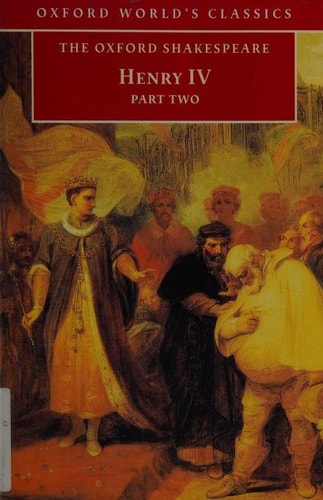
The Oxford Shakespeare: Henry IV, Part Two
0
0
As an Amazon Associate and affiliate partner, Menrva Books earns from qualifying purchases. Learn more
Author Description
This edition offers a fully modernized text of one of Shakespeare's most fascinating plays. Henry IV, Part 2 is the only play in the canon whose structure almost exactly mirrors that of its predecessor, and thereby affords unique perspectives on Shakespeare's art and craft. Far from being the impoverished country cousin of an illustrious work, Part 2 introduces unforgettable new characters like Pistol and Shallow, and memorable minor players such as Doll Tearsheet and the reluctant Goucestershire recruits. Above all, it gives us more Falstaff. Although he is now politically distanced from Hal, he looms larger than ever as a mischievous figure who never ceases to fascinate with his unique blend of native wit, inventiveness, and corruption. Through a radical reconsideration of the play's text(s) and date, it is argued here for the first time that the character of Falstaff was called Oldcastle in Part 2 as well as in as in Part 1, and that it was the vetting of Part 2 for the 1596-7 Christmas performances at Court which led to the change of name in both plays. This edition moreover takes the view that the Folio-only passages in the play reflect the text of the original prompt-book.
Menrva's Summary
THE PULSE
The aging King Henry IV struggles to maintain his grip on a fractured kingdom while his son, Prince Hal, navigates the moral chasm between his roguish companions and his royal responsibilities. As the rebellion against the crown reaches its final, weary stages, the narrative shifts between the high-stakes political maneuvering of the court and the gritty, comedic underworld of Eastcheap. The play utilizes a multi-layered structure to contrast the decline of the monarch with the maturation of the heir, all while Falstaff attempts to exploit the shifting political landscape for personal gain. This edition presents the text through a modernized lens, emphasizing the structural symmetry between this work and its predecessor.
INSIDE THE PAGES
- Exploration of the transition from rebellion to political consolidation
- Introduction of distinct comedic figures such as Pistol and Shallow
- Examination of the complex relationship between Prince Hal and Falstaff
- Use of Gloucestershire as a setting to provide social contrast to the court
- Analysis of the Folio-only passages as indicators of the original prompt-book
- Focus on the evolution of Falstaff as a character of wit and corruption
- Integration of historical context regarding the naming of characters
- Structural mirroring of the preceding play in the series
THE COLLECTIVE ECHO
Readers frequently highlight the play's unique ability to balance somber political reflection with the raucous humor of its secondary characters. Discussion often centers on the psychological depth of Falstaff, whose presence is viewed as both a source of levity and a symbol of the moral decay the new king must eventually reject. Critics appreciate the scholarly rigor of this edition, particularly its arguments regarding the play's textual history and the original naming conventions of its characters. The work is widely regarded as a sophisticated study of power, aging, and the inevitable cost of assuming authority.
Page Count:
296
Publication Date:
1998-04-30
Publisher:
Clarendon Press
ISBN-10:
0198123647
ISBN-13:
9780198123644
Drama
classic
Dramatic works
Plays
Historical
English literature
Community Tags
Similar Books