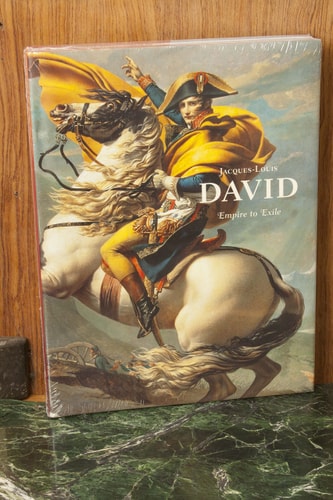
Empire to Exile
0
0
As an Amazon Associate and affiliate partner, Menrva Books earns from qualifying purchases. Learn more
Author Description
This beautifully illustrated book, focusing on a selection of later paintings and drawings by Jacques-Louis David (1748-1825), is published to accompany the first major exhibition of the artist’s work in the United States. Organized by the Sterling and Francine Clark Art Institute and the J. Paul Getty Museum, this exhibition of 27 paintings and 29 drawings is also the first to examine the transformation of David’s art during the post-Revolutionary period (1800-1825). Each of the works, many of which were previously unknown or inaccessible, is reproduced in color and accompanied by an entry with complete scholarly information. Art historian Philippe Bordes establishes David’s position after the Terror and discusses the artist’s admiration for Napoleon Bonaparte, for whom he served as court painter. The book also investigates David’s new approach to antiquity in historical compositions and the avowed influence of the Flemish School on his practice. Drawing on many new documents and close analysis of the works featured in the book, Bordes offers a revised understanding of this deeply reactive artist and the creative output of his second career.
Menrva's Summary
THE THESIS
This book examines the transformation of Jacques-Louis David's art during the post-Revolutionary period (1800-1825). The exhibition and accompanying catalogue focus on later paintings and drawings by the artist, many of which were previously unknown or inaccessible. Art historian Philippe Bordes establishes David's position after the Terror, discusses his admiration for Napoleon Bonaparte, and investigates his new approach to antiquity and the influence of the Flemish School. Drawing on new documents and close analysis, the book offers a revised understanding of this deeply reactive artist and the creative output of his second career.
THE SCOPE MAP
- Later paintings and drawings by Jacques-Louis David (1748-1825)
- Examination of David's art during the post-Revolutionary period (1800-1825)
- Scholarly entries with complete information for each reproduced work
- Discussion of David's admiration for Napoleon Bonaparte and his role as court painter
- Investigation of David's new approach to antiquity in historical compositions
- Analysis of the avowed influence of the Flemish School on David's practice
- Use of new documents and close analysis of the featured works
THE AUTHORITY PERSPECTIVE
This catalogue, accompanying the first major exhibition of Jacques-Louis David's work in the United States, offers a scholarly examination of his post-Revolutionary period. Art historian Philippe Bordes provides new insights into David's artistic evolution, supported by detailed analysis of previously inaccessible works. The book is structured to present a revised understanding of the artist's later career, focusing on his engagement with historical compositions and stylistic influences. The scholarly nature of the entries and the focus on new documentation suggest it is a valuable resource for art historians and enthusiasts of Neoclassical art.
Page Count:
379
Publication Date:
2005-01-01
Publisher:
Yale University Press
ISBN-10:
0300104472
ISBN-13:
9780300104479
Non-Fiction
Art
European Art
French Art
Art History
Neoclassicism
Community Tags
Similar Books