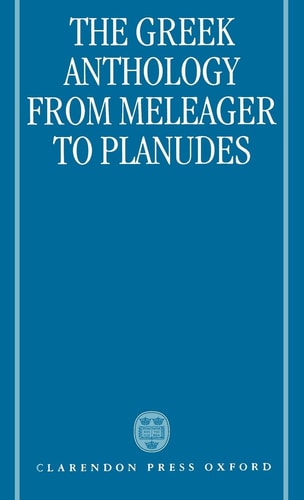
The Greek Anthology: From Meleager to Planudes
0
0
As an Amazon Associate and affiliate partner, Menrva Books earns from qualifying purchases. Learn more
Author Description
The Greek Anthology is one of the great books of European literature, "a garden containing the flowers and weeds of 1500 years of Greek epigram." Cameron's study adds a wealth of new information about its growth over an even longer period, from the earliest papyrus anthologies down to the 1606 rediscovery of the Palatine Anthology (AP), our principal source for the entire history of Greek epigram, from Simonides to the Byzantine age. It was a Byzantine schoolmaster, Constantine Cephalas, who excerpted all the major ancient collections around 900. His work is reconstructed from a closer analysis of AP (ca 940) and the various later collections. Following a number of neglected clues, Cameron identifies the compiler of AP as Constantine the Rhodian, and solves the mystery of the wanderings of AP during the renaissance, showing that it once belonged to Sir Thomas More.
Menrva's Summary
THE THESIS
This work investigates the historical development, compilation, and transmission of the Greek Anthology from its earliest papyrus origins to its rediscovery in the Renaissance. Alan Cameron, a distinguished scholar of late antiquity, utilizes a rigorous analysis of the Palatine Anthology and various Byzantine sources to reconstruct the editorial history of these epigrams. By examining neglected manuscript evidence and historical clues, he provides a definitive account of how these collections were assembled and preserved over fifteen centuries.
THE SCOPE MAP
What You Will Find
- A detailed reconstruction of the editorial work of Constantine Cephalas and the compilation of the Palatine Anthology.
- Identification of the compiler of the Palatine Anthology as Constantine the Rhodian.
- An analysis of the provenance and movement of the Palatine Anthology through the Renaissance, including its ownership by Sir Thomas More.
- A comprehensive survey of Greek epigrammatic history spanning from the era of Simonides to the Byzantine period.
THE AUTHORITY PERSPECTIVE
Scholars and classicists recognize this text as a foundational study for understanding the transmission of Byzantine and ancient Greek literature. Readers frequently note the academic density of the prose and the meticulous nature of Cameron's archival research.
Page Count:
432
Publication Date:
1993-06-24
Publisher:
Clarendon Press
ISBN-10:
0198140231
ISBN-13:
9780198140238
Poetry
History
Greek poetry
Academic
Literary Criticism
Epigrams
Community Tags
Similar Books