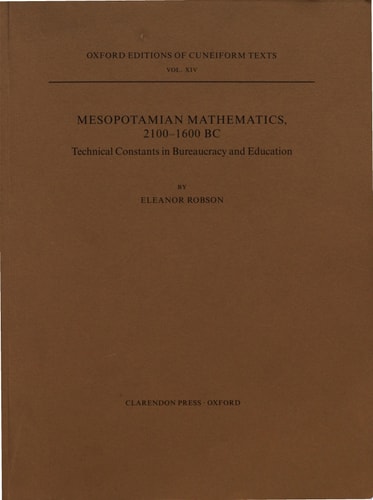
Mesopotamian Mathematics 2100-1600 BC: Technical Constants in Bureaucracy and Education
0
0
As an Amazon Associate and affiliate partner, Menrva Books earns from qualifying purchases. Learn more
Author Description
Mathematics was integral to Mesopotamian scribal culture: indeed, writing was invented towards the end of the fourth millennium B.C. for the express purpose of recording numericalatical information. The main body of this book is a mathematical and philological discussion of the two hundred technical constants, or "coefficients", found in early second millennium mathematics. Their names and mathematical functions are established, leading to improved interpretations of several large mathematical topics. The origins of many coefficients--and much of the more practical mathematics--are traced to late third millennium accounting and quantity surveying practices. Finally, the coefficients are used to examine some aspects of mathematics education in early Mesopotamia.
Menrva's Summary
THE THESIS
This work investigates the role and function of technical constants, or coefficients, within the scribal culture and educational systems of early second millennium Mesopotamia. Eleanor Robson, a specialist in the history of mathematics and cuneiform studies, utilizes a rigorous philological and mathematical analysis of over two hundred identified coefficients. By tracing these constants back to late third millennium accounting and quantity surveying practices, the author establishes a framework for understanding how practical administrative needs influenced the development of mathematical theory and pedagogy in the region.
THE SCOPE MAP
What You Will Find
- A comprehensive catalog and functional analysis of over two hundred Mesopotamian mathematical coefficients.
- Philological examination of cuneiform texts related to scribal education and administrative record-keeping.
- Historical reconstruction of the transition from practical accounting to theoretical mathematics.
- Evidence-based methodology linking bureaucratic practices to the evolution of mathematical instruction.
THE AUTHORITY PERSPECTIVE
Scholars and historians of science frequently cite this text as a foundational resource for understanding the intersection of ancient bureaucracy and mathematical development. Readers often note the high level of academic density and the specialized nature of the linguistic analysis provided throughout the volume.
Page Count:
352
Publication Date:
1999-07-29
Publisher:
Clarendon Press
ISBN-10:
0198152469
ISBN-13:
9780198152460
History
Ancient History
Mathematics history
Reference
Mathematics
Education
Archaeology
Community Tags
Similar Books