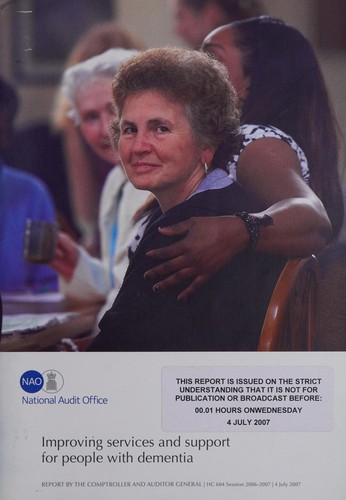
Improving services and support for people with dementia
0
0
As an Amazon Associate and affiliate partner, Menrva Books earns from qualifying purchases. Learn more
Author Description
Dementia is a term for a range of progressive, terminal organic brain diseases, including Alzheimer's. Some 560,000 people in England are estimated to have dementia, with a steeply rising trend over the coming years. Some 476,000 people are unpaid carers of people with dementia. Direct costs to the NHS and social care are currently at least £3.3 billion a year, but the overall annual economic burden is estimated at £14.3 billion. This report examines what health and social care services are available for people with dementia and their unpaid carers in England and whether they are providing effective and good quality support. Until 2005 the Department of Health attached little priority to dementia, and progress was hampered by a lack of good quality data, by stigma, and by the low level of political and national focus on older people's mental health. The NAO conclude that services are not currently delivering value for money to taxpayers or people with dementia and their families. Whilst health and social care services are spending significantly on dementia, spending is late - too few people are being diagnosed or being diagnosed early enough. Early interventions that are known to be cost-effective, and which would improve quality of life, are not being made widely available. Services in the community, care homes and at the end of life are not delivering consistently or cost-effectively against the objective of supporting people to live independently as long as possible in the place of their choosing. The rapid ageing of the population means costs will rise and services are likely to become increasingly inconsistent and unsustainable without redesign. Recommendations cover: improving diagnosis and early intervention; improving management of services; gearing the system to respond to the major challenges of dementia in the future.
Menrva's Summary
THE THESIS
The National Audit Office investigates the effectiveness and value for money of dementia services in England. The report examines the current availability and quality of health and social care services for people with dementia and their unpaid carers, highlighting that despite significant spending, services are not delivering optimal outcomes or cost-effectiveness. It identifies key issues such as late diagnosis, insufficient early intervention, and inconsistent support across community, residential, and end-of-life care. The NAO concludes that without significant redesign, rising costs due to an aging population will render services unsustainable.
THE SCOPE MAP
- Analysis of current health and social care services for people with dementia in England.
- Assessment of the effectiveness and quality of support for individuals with dementia and their unpaid carers.
- Examination of the financial costs associated with dementia, including direct NHS and social care expenditure and broader economic burdens.
- Identification of barriers to progress, such as historical lack of priority, data deficiencies, stigma, and low focus on older people's mental health.
- Evaluation of the extent to which services support independent living and choice.
- Recommendations for improving diagnosis, early intervention, service management, and future system responsiveness.
- Discussion of the impact of an aging population on future dementia care costs and service sustainability.
THE AUTHORITY PERSPECTIVE
The National Audit Office's report critically assesses the current state of dementia services in England, concluding that they are not currently delivering value for money for taxpayers or those affected by dementia. The report highlights significant shortcomings in diagnosis, early intervention, and ongoing care, particularly in community and end-of-life settings. It emphasizes the urgent need for service redesign to address the escalating costs and inconsistencies driven by the aging population. The NAO's recommendations focus on improving diagnostic pathways, enhancing service management, and preparing the system for future demographic challenges.
Page Count:
72
Publication Date:
2007-01-01
ISBN-10:
0102945616
ISBN-13:
9780102945614
Health
Non-Fiction
Politics
Government Report
Dementia
Public Health
Social Care
Community Tags
Similar Books