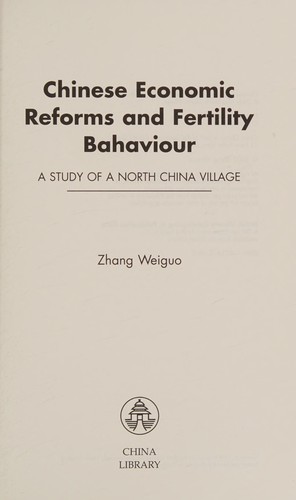
Chinese Economic Reforms and Fertility Behaviour
0
0
As an Amazon Associate and affiliate partner, Menrva Books earns from qualifying purchases. Learn more
Author Description
This is the first study of its kind to apply an institutional framework to advance our understanding of the interplay between macro-economic and population policies on the one hand and micro-fertility behaviour on the other in post-reform rural China. The research is based on primary fieldwork data accumulated over a period of seventeen months in a Hebei village (north China) from July 1992 to November 1993. It depicts the ways in which individual fertility motivations have been influenced by two decades of state-instigated economic reforms. The changing institution of marriage, family structure and systems and the community authority structure are amongst the themes examined in depth. In contrast to the expectations of scholars and government, however, contemporary couples not only prefer to have fewer children, their motivation for having girls has also become stronger, although the preference for sons persists. Clearly, individual fertility does not follow strictly the state norms, and the state-planned birth policy is increasingly mediated by individual desires and the discretionary decisions taken by local government.--Jacket.
Menrva's Summary
THE THESIS
This book investigates the complex relationship between China's economic reforms and the fertility behaviors of its rural population. The research, based on seventeen months of fieldwork in a Hebei village between 1992 and 1993, examines how two decades of state-initiated economic changes have influenced individual fertility motivations. It delves into the evolving institutions of marriage, family structure, and community authority, revealing how these shifts interact with macro-economic and population policies to shape micro-fertility decisions. The study highlights a nuanced reality where contemporary couples not only desire fewer children but also show a stronger motivation for having daughters, despite the persistent preference for sons.
THE SCOPE MAP
- Analysis of the interplay between macro-economic policies and micro-fertility behavior in post-reform rural China.
- Primary fieldwork data collected over seventeen months in a Hebei village (July 1992
- November 1993).
- Depiction of how individual fertility motivations were influenced by two decades of state-instigated economic reforms.
- Examination of the changing institutions of marriage, family structure, and community authority.
- Exploration of contemporary couples' preferences for fewer children and a stronger motivation for having daughters.
- Discussion on how individual fertility decisions diverge from state norms and are mediated by individual desires and local government discretion.
THE AUTHORITY PERSPECTIVE
This study is noted as the first of its kind to apply an institutional framework to understand the connection between economic and population policies and fertility behavior in rural China. The research provides detailed insights from primary fieldwork, challenging scholarly and governmental expectations regarding fertility preferences. It highlights the complex interplay of individual desires, evolving social structures, and state policy in shaping family size and composition. The findings suggest that state-planned birth policies are increasingly mediated by personal aspirations and local administrative decisions.
Page Count:
276
Publication Date:
2002-01-01
ISBN-10:
1873410492
Economics
Science
Non-Fiction
History
Business
Demographics
China Studies
Sociology
Community Tags
Similar Books