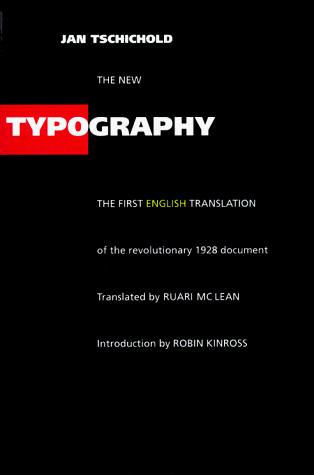
The New Typography
0
0
As an Amazon Associate and affiliate partner, Menrva Books earns from qualifying purchases. Learn more
Author Description
Since its intitial publication in Berlin in 1928, Jan Tschichold's The New Typography has been recognized as the definitive treatise on book and graphic design in the machine age. At once a key theoretical document of Central European modernism between the world wars and an invaluable source of working principles for the practicing designer, this classic work enjoys the reputation among book artists that Le Corbusier's Toward a New Architectire has long held among architects. The book's legendary renown is certain to increase with the long-overdue appearance of this first English translation, published in a form that reflects Tschichold's original typography and design. Ranging from theoretical discussions of typography in the age of photography and mechanical standardization to practical considerations in designing business forms, The New Typography remains essential reading for designers, art historians, and all those concerned with the evolution of visual communication in the twentieth century.
Menrva's Summary
THE THESIS
Jan Tschichold's seminal work, The New Typography, explores the principles of modern design in the context of the machine age. First published in 1928, this book serves as both a theoretical cornerstone of Central European modernism and a practical guide for contemporary designers. Tschichold, a key figure in modernist typography, presents his arguments with a clarity that has cemented the book's status as a foundational text in graphic design. The work bridges theoretical discussions on typography's role alongside photography and mass production with actionable advice for creating effective visual communication.
THE SCOPE MAP
- Theoretical discussions on typography in the age of photography
- Considerations for mechanical standardization in design
- Practical principles for designing business forms
- Analysis of the evolution of visual communication in the 20th century
- Exploration of the relationship between typography and new technologies
- Emphasis on asymmetrical layouts and sans-serif typefaces
- Discussion of the role of the designer in a modern industrial society
THE AUTHORITY PERSPECTIVE
The New Typography is widely regarded as a definitive treatise on graphic design and typography from the machine age. Its initial publication in 1928 marked it as a key theoretical document of interwar Central European modernism. The first English translation, published in 1995, has been essential reading for designers, art historians, and anyone interested in 20th-century visual communication. The book's enduring influence is comparable to that of Le Corbusier's architectural manifestos, solidifying its place as a classic in the field.
Page Count:
236
Publication Date:
1995-01-01
ISBN-10:
0520071468
Non-Fiction
Art
Modernism
Typography
Graphic Design
Art History
Community Tags
Similar Books