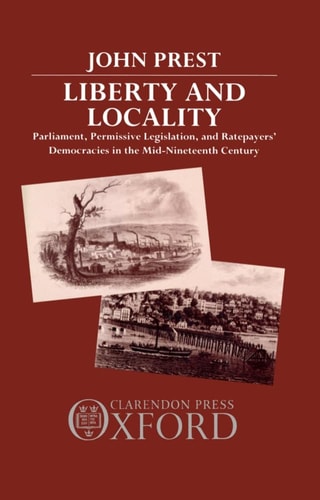
Liberty and Locality: Parliament, Permissive Legislation, and Ratepayers' Democracies in the Nineteenth Century
0
0
As an Amazon Associate and affiliate partner, Menrva Books earns from qualifying purchases. Learn more
Author Description
This is a study of local government and permissive legislation in nineteenth-century Britain. In the eighteenth century, every locality that wished to improve or police its streets had to obtain its own private Act of Parliament. By the nineteenth century, when the construction of a habitable urban environment had become a matter of urgency, Parliament had recourse to "permissive" or "adoptive" legislation. Parliament thus facilitated, but did not require, local action, and as long as the initiative and responsibility remained in local hands, relations between central and local government were relaxed. Including detailed case-studies of the Isle of Wight, Huddersfield, and Fife, Liberty and Locality will especially appeal to lawyers and political, social, and local historians.
Menrva's Summary
THE THESIS
This study investigates the evolution of local government in nineteenth-century Britain through the lens of permissive legislation and the shifting relationship between central parliamentary authority and local autonomy. John Prest, a historian of British political and social structures, examines how the transition from private Acts of Parliament to adoptive legislation allowed for the development of urban infrastructure. The book argues that by facilitating rather than mandating local action, Parliament maintained a flexible governance model that preserved local initiative and responsibility.
THE SCOPE MAP
What You Will Find
- Analysis of the transition from private local Acts to general permissive legislation
- Detailed case studies of the Isle of Wight, Huddersfield, and Fife
- Examination of the administrative mechanisms behind urban improvement and policing
- Historical assessment of the balance between central oversight and ratepayers' democracies
THE AUTHORITY PERSPECTIVE
Historians and legal scholars identify this work as a significant contribution to the study of nineteenth-century administrative history. Readers frequently note the academic density of the prose and the precision of the regional case studies provided by the author.
Page Count:
248
Publication Date:
1990-05-17
Publisher:
Clarendon Press
ISBN-10:
0198201753
ISBN-13:
9780198201755
History
Local government
Nineteenth century
British History
Government
Law
Community Tags
Similar Books