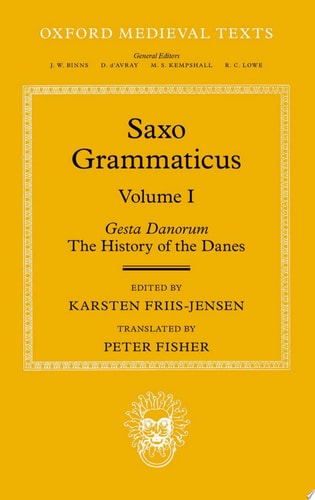
Saxo Grammaticus (Volume I): Gesta Danorum: The History of the Danes
0
0
As an Amazon Associate and affiliate partner, Menrva Books earns from qualifying purchases. Learn more
Author Description
Saxo was probably a canon of Lund Cathedral, at that period a Danish cathedral, and lived at the end of the twelfth century. He was in the service of Archbishop Absalon, who encouraged him to write a history of his own country from the beginnings up to his own time, with a strong Christian bias. Starting with the myths and heroic tales of primitive Scandinavia, he devoted the first nine of his sixteen books to legendary material before dealing with the first kings of the Viking age and finished in 1285, after relating the earlier exploits of King Cnut Valdemarsson. The activities of the Danish kings were intimately bound up with the monarchies of Norway and Sweden; Cnut the Great, one of Saxo's heroes, whose empire stretched as far as Britain and Iceland, was ruler of both these countries. In the last books Saxo took particular concern to describe the campaigns of Valdemar the Great and his warrior archbishop, Absalon, against the Wends of North Germany.The work is a prosimetrum, that is, in six of the first nine books he inserts poems, which are intended to parallel specimens of old Danish heroic poetry in Latin metres. Saxo's Latin prose style is often complex, based as it is on models like Valerius Maximus and Martianus Capella, but he is a lively and compelling story-teller, often displaying a rather sly sense of humour, and an interest in the supernatural. He is the first author to give a full account of Hamlet, whose adventures he relates at some length, the elements of which in a great many respects correspond surprisingly closely with the characters and incidents of Shakespeare's play.Volume I of Saxo Grammaticus contains an introduction from the editor, and the first ten books of Saxo's work.
Menrva's Summary
THE THESIS
This volume investigates the early history of Denmark by examining the foundational text of Saxo Grammaticus, a twelfth-century canon who sought to document his nation's origins through a blend of myth, heroic legend, and political chronicle. The editor, Peter Fisher, provides a scholarly framework that contextualizes Saxo's work within the service of Archbishop Absalon. By analyzing the transition from primitive Scandinavian folklore to the established Viking age monarchies, the text argues that Saxo's writing served as both a nationalistic record and a sophisticated literary exercise in Latin prose.
THE SCOPE MAP
What You Will Find
- A comprehensive translation of the first ten books of Gesta Danorum.
- Analysis of the prosimetrum literary style, which integrates Latin poetry with historical prose.
- Historical accounts of the Viking age, including the reign of Cnut the Great and the campaigns of Valdemar the Great.
- Scholarly commentary on the early literary origins of the Hamlet legend.
THE AUTHORITY PERSPECTIVE
Experts recognize this edition as a foundational resource for students of medieval Scandinavian history and Latin literature. Readers frequently note the academic density of the prose, which reflects the complex stylistic models Saxo employed in his original writing.
Page Count:
880
Publication Date:
2015-05-26
Publisher:
Oxford University Press
ISBN-10:
0198205236
ISBN-13:
9780198205234
Biography
History
Mythology
Classical
Scandinavian History
Community Tags
Similar Books