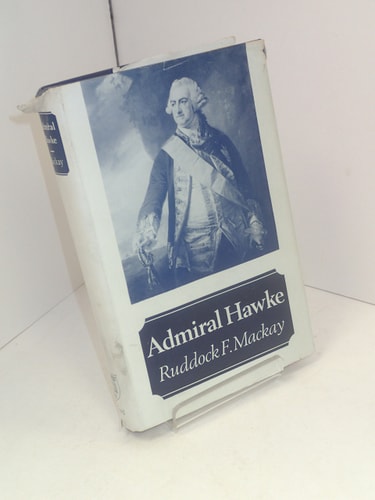
Admiral Hawke
0
0
As an Amazon Associate and affiliate partner, Menrva Books earns from qualifying purchases. Learn more
Author Description
Although less well known than Nelson, Hood, or Rodney, Hawke is one of the founding fathers of the Royal Navy's 'habit of victory'. His moral courage was manifest early, when in 1744 as a junior captain he took his ship out of the line at the battle of Toulon to engage the enemy more closely. This revisionist biography reinstates him as one of the most significant figures in the history of the Navy. As an admiral Hawke did not lose this innovative spirit. It was during the Seven Years War that he really made his mark, when he proved that the year-round close blockade of Brest was feasible, which became the cornerstone of British naval policy right down to 1815. With the French main fleet bottled up, invasion of the British Isles was impossible, and even if it did escape during bad weather, pursuit was always close astern. This was dramatically demonstrated on a stormy November day in 1759 when Hawke's fleet chased a startled French squadron into the poorly charted shallows of Quiberon Bay. In the course of a wild and chaotic night the British won a victory so spectacular that it was a favourite subject for marine painters for nearly a century. Unlike Nelson, Hawke rose to the pinnacle of his profession, eventually becoming First Lord of the Admiralty. Like many peacetime administrators, struggling against budget limitations, Hawke was later criticised for the state of the fleet when mobilisation called. But this book shows that his work was very creditable, and reinforced his position as the Navy's foremost figure.
Menrva's Summary
THE THESIS
This biography investigates the career of Admiral Edward Hawke to determine his foundational role in establishing the Royal Navy's strategic dominance during the eighteenth century. Ruddock F. MacKay utilizes primary naval records and historical correspondence to challenge the relative obscurity of Hawke compared to contemporaries like Nelson. The author argues that Hawke's innovative tactical decisions and administrative leadership during the Seven Years War provided the blueprint for British naval policy for decades to come.
THE SCOPE MAP
What You Will Find
- Analysis of the 1744 Battle of Toulon and its impact on naval engagement tactics.
- Examination of the strategic implementation of the year-round close blockade of Brest.
- Detailed account of the 1759 Battle of Quiberon Bay and its historical significance.
- Evaluation of Hawke's administrative tenure as First Lord of the Admiralty amidst budget constraints.
THE AUTHORITY PERSPECTIVE
Historians recognize this work as a critical revisionist text that successfully elevates Hawke's standing within the canon of British naval leadership. Readers frequently note the meticulous research and the author's ability to contextualize complex maritime strategy for a general audience.
Page Count:
388
Publication Date:
1965-01-01
Publisher:
Clarendon Press Oxford University
ISBN-10:
0198213239
ISBN-13:
9780198213239
Biography
History
Naval history
Military History
Community Tags
Similar Books