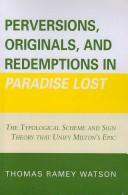
Perversions, Originals, and Redemptions in Paradise Lost
0
0
As an Amazon Associate and affiliate partner, Menrva Books earns from qualifying purchases. Learn more
Author Description
Foreword -------- The main argument of Thomas Watson's book is to highlight how John Milton accepts and adapts Augustine’s concept of “signs” as the means by which humankind discerns the immanence of God in the human condition. Using biblical typology as a point of departure, whereby the Hebraic scriptures are interpreted as prefigurations of the Christian New Testament, Augustine and Milton developed a “sign theory” or semiotics. Milton’s achievement is to dramatize this “sign theory” in his major poetry, especially his 12-book epic, Paradise Lost. That is to say, in the epic, Milton’s God has inscribed into his Creation the signs that humankind must properly read and interpret. Accordingly, in the epic there are instances of Adam and Eve interacting with one another, or with others (whether Raphael or Satan, for instance), rightly and wrongly. That is, the choices made by Adam and Eve are right or wrong depending upon whether they have or have not correctly discerned the “will” of God. One of the ironies to illustrate the implications of discernment involves Eve’s separation from Adam at the outset of Book IX in Paradise Lost. While separated from her husband, Eve notices that the male and female principles in the garden, respectively the tree and vine, are disunited; and she reunites them. But she remains oblivious of the implications of her horticulture, for she would have rapidly reunited with Adam if she had discerned how the very actions she performed signify how she should have remained alongside her spouse. The remarkable achievement of this manuscript, however, is to explicate how “signs” are evident in the very language of the epic, how, that is, the very language is informed with significance. To my knowledge this study is innovative in its outlook and explication. The book is effectively organized. It begins with the context and framework of Augustinian “sign theory,” and Milton’s adaptation thereof. Proceeding next to accentuate the conflict b
Menrva's Summary
THE THESIS
This book argues that John Milton's epic poem, Paradise Lost, dramatizes Augustine's concept of 'signs' as the means by which humanity discerns God's presence in the human condition. The author, Thomas Leonard Watson, explores how Milton adapted Augustinian semiotics, or 'sign theory,' into his poetry, particularly in Paradise Lost. The central thesis posits that God has embedded signs within Creation that humanity must correctly interpret. The book examines instances where characters like Adam and Eve rightly or wrongly discern God's will through these signs, with Eve's separation from Adam in Book IX serving as a key example of misinterpretation. Furthermore, Watson highlights how the very language of Paradise Lost is imbued with significance, presenting an innovative approach to understanding the epic's layered meaning.
THE SCOPE MAP
- Exploration of Augustine's concept of 'signs' and its adaptation by John Milton.
- Analysis of biblical typology as a foundation for Milton's 'sign theory'.
- Demonstration of how Milton's Paradise Lost dramatizes this 'sign theory'.
- Examination of God inscribing interpretative signs into Creation.
- Case studies of Adam and Eve's interactions and their discernment of God's will.
- Detailed analysis of Eve's separation from Adam in Book IX as an illustration of misinterpretation.
- Explication of 'signs' within the language of Paradise Lost itself.
- Discussion of the innovative outlook and explication presented in the study.
THE AUTHORITY PERSPECTIVE
The book is structured logically, beginning with the theoretical framework of Augustinian 'sign theory' and Milton's engagement with it. It then proceeds to analyze the conflict presented within Paradise Lost, focusing on the implications of correctly or incorrectly interpreting divine signs. The author's approach is noted as innovative in its explication of how signs are evident within the very language of the epic. The foreword suggests that the manuscript effectively highlights Milton's dramatization of this semiotic theory.
Page Count:
188
Publication Date:
2007-01-01
ISBN-10:
0761837817
ISBN-13:
9780761837817
Classics
Non-Fiction
Literary Criticism
Community Tags
Similar Books