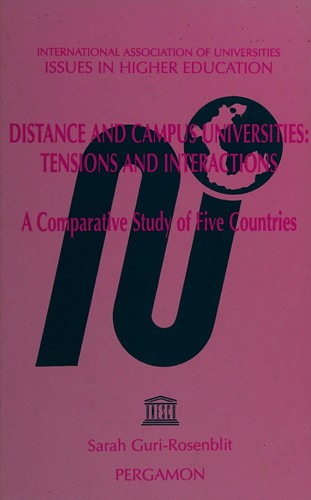
Distance and Campus Universities
0
0
As an Amazon Associate and affiliate partner, Menrva Books earns from qualifying purchases. Learn more
Author Description
This book compares the emergence and development of autonomous, fully fledged distance teaching universities (DTUs) in five higher education systems: the UK, Germany, Spain, Canada and Israel. It examines the evolution and the functional roles of the DTUs as they faced and dealt with challenges such as open admission, unprepared students, part-time students, flexible curricula, innovative learning/teaching, modes, making use of advanced technologies, creating 'virtual classrooms', modularization and international cooperation - issues which appeared on the agenda of 'traditional', 'conventional' campus universities within a decade or two. It provides a synthesis of higher education literature and distance education literature, which are currently almost totally isolated and which rarely refer to one another. It examines the commonalities and divergences between the five DTUs - a timely observation, after two decades of operation, of the unique and variable national impacts on the nature and profile of each DTU, and ends with an analysis of the main lessons to be derived from past experiences of the DTUs as they might apply to the future planning of both conventional universities and providers of distance higher education.--Jacket.
Menrva's Summary
THE THESIS
This book investigates the establishment and evolution of autonomous distance teaching universities (DTUs) across five distinct higher education systems. It analyzes how these institutions navigated challenges such as open admissions, diverse student preparedness, flexible curricula, and the integration of advanced technologies to create virtual classrooms. The work synthesizes literature from both higher education and distance education fields, which are often treated in isolation. By examining commonalities and divergences among DTUs in the UK, Germany, Spain, Canada, and Israel, the book offers insights into the unique national impacts on their development and provides lessons for future planning in both conventional and distance education.
THE SCOPE MAP
- Comparative analysis of Distance Teaching Universities (DTUs) in the UK, Germany, Spain, Canada, and Israel.
- Examination of challenges faced by DTUs: open admission, unprepared students, part-time students.
- Exploration of flexible curricula and innovative learning/teaching modes.
- Discussion on the utilization of advanced technologies and the creation of 'virtual classrooms'.
- Synthesis of higher education and distance education literature.
- Analysis of commonalities and divergences between the five DTUs studied.
- Assessment of unique and variable national impacts on DTU profiles.
- Derivation of lessons from DTU experiences for future planning of higher education institutions.
THE AUTHORITY PERSPECTIVE
The book offers a comparative study of distance teaching universities, synthesizing disparate bodies of literature on higher and distance education. It examines the operational challenges and innovations within these institutions across five countries, providing a historical perspective on their development. The analysis aims to draw lessons applicable to the future planning of both traditional campus universities and distance education providers. The work is positioned as a timely observation after two decades of DTU operation.
Page Count:
290
Publication Date:
1999-01-01
ISBN-10:
008043066X
Non-Fiction
History
Science & Technology
Educational Technology
Comparative Education
Higher Education
Community Tags
Similar Books