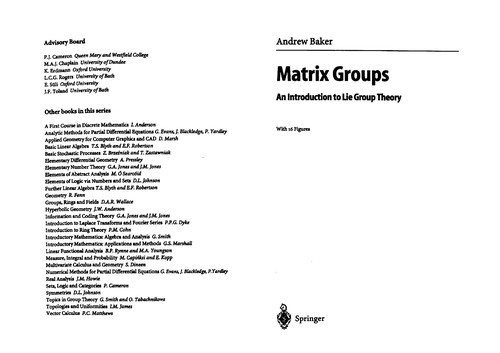
Matrix Groups
0
0
As an Amazon Associate and affiliate partner, Menrva Books earns from qualifying purchases. Learn more
Author Description
Aimed at advanced undergraduate and beginning graduate students, this book provides a first taste of the theory of Lie groups as an appetiser for a more substantial further course. Lie theoretic ideas lie at the heart of much of standard undergraduate linear algebra and exposure to them can inform or motivate the study of the latter. The main focus is on matrix groups, i.e., closed subgroups of real and complex general linear groups. The first part studies examples and describes the classical families of simply connected compact groups. The second part introduces the idea of a lie group and studies the associated notion of a homogeneous space using orbits of smooth actions. Throughout, the emphasis is on providing an approach that is accessible to readers equipped with a standard undergraduate toolkit of algebra and analysis. Although the formal prerequisites are kept as low level as possible, the subject matter is sophisticated and contains many of the key themes of the fully developed theory, preparing students for a more standard and abstract course in Lie theory and differential geometry.
Menrva's Summary
THE THESIS
This book introduces the theory of Lie groups, focusing on matrix groups as an accessible entry point for advanced students. The text aims to provide a foundational understanding of Lie theoretic ideas, which are central to linear algebra, by examining closed subgroups of real and complex general linear groups. It covers examples and the classical families of simply connected compact groups before delving into the concept of a Lie group and its associated homogeneous spaces. The approach is designed for readers with a standard undergraduate background in algebra and analysis, preparing them for more abstract studies in Lie theory and differential geometry.
THE SCOPE MAP
- Introduction to the theory of Lie groups with a focus on matrix groups.
- Exploration of closed subgroups of real and complex general linear groups.
- Study of examples and classical families of simply connected compact groups.
- Introduction to the concept of a Lie group and associated homogeneous spaces.
- Use of orbits of smooth actions to study homogeneous spaces.
- Emphasis on an accessible approach for undergraduate students of algebra and analysis.
- Preparation for more advanced abstract courses in Lie theory and differential geometry.
THE AUTHORITY PERSPECTIVE
The book is positioned as an introductory text for advanced undergraduate and beginning graduate students, serving as an appetizer for more substantial courses in Lie theory. Its approach emphasizes accessibility for those with a standard undergraduate toolkit in algebra and analysis, aiming to demystify the sophisticated subject matter. By focusing on matrix groups and key themes of the fully developed theory, it prepares students for abstract courses in Lie theory and differential geometry. The text is designed to inform and motivate the study of linear algebra through the lens of Lie theoretic ideas.
Page Count:
330
Publication Date:
2002-01-01
ISBN-10:
1852334703
Science
Non-Fiction
Linear Algebra
Differential Geometry
Algebra
Mathematics
Community Tags
Similar Books