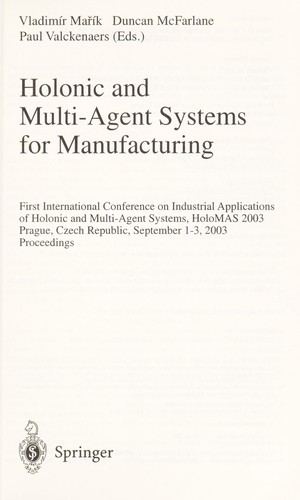
Holonic and Multi-Agent Systems for Manufacturing
0
0
As an Amazon Associate and affiliate partner, Menrva Books earns from qualifying purchases. Learn more
Author Description
The increasing complexity of manufacturing systems as well as the overall demands for flexible and fault-tolerant control of production processes stimulates (among many others) two key emerging technologies that are already making an important breakthrough in the field of intelligent manufacturing, control, and diagnostics. These two paradigms are: • the holonic approach based on the event-driven control strategy, usually aimed at modular control systems that are directly physically linked with the manufacturing hardware equipment, and • the multi-agent approach developed in the area of distributed information processing. The research communities working in both these fields are approaching the problem of intelligent manufacturing from different viewpoints and, until recently, to a certain extent, in an independent way. We can however observe quite a clear convergence of these fields in the last few years: the communities have started to cooperate, joining efforts to solve the painful problems involved in achieving effective industrial practice. We can see convergence in the terminology, standards and methods being applied.
Menrva's Summary
THE THESIS
The increasing complexity and demands for flexible, fault-tolerant control in manufacturing systems have spurred the development of two key technologies: the holonic approach and the multi-agent approach. The holonic approach focuses on event-driven control for modular systems directly linked to hardware, while the multi-agent approach addresses distributed information processing. Though initially developed independently, these fields are converging, with researchers cooperating to solve practical industrial challenges and finding common ground in terminology, standards, and methods.
THE SCOPE MAP
- Exploration of the holonic approach to manufacturing control, emphasizing event-driven strategies and modular systems.
- Detailed examination of the multi-agent approach for distributed information processing in industrial contexts.
- Analysis of the convergence between holonic and multi-agent systems in recent years.
- Discussion of shared terminology, standards, and methodologies being adopted by both research communities.
- Case studies or examples illustrating the practical application of these technologies in intelligent manufacturing.
- Insights into the challenges and solutions for achieving effective industrial practice through these paradigms.
- Focus on control, diagnostics, and flexible production processes within complex manufacturing environments.
THE AUTHORITY PERSPECTIVE
This collection of papers from the 1st International Conference on Industrial Applications of Holonic and Multi-Agent Systems presents a snapshot of research at the intersection of these two critical technologies. The content reflects a growing consensus and collaborative effort within the academic and industrial communities to leverage holonic and multi-agent systems for advanced manufacturing. The discussions likely highlight the practical challenges and emerging solutions in creating more flexible, intelligent, and fault-tolerant production processes. The convergence of these fields suggests a forward-looking perspective on the future of industrial automation and control.
Page Count:
322
Publication Date:
2003-01-01
ISBN-10:
3540407510
Science & Technology
Science
Business
Art
Non-Fiction
Automation
Control systems
Distributed Systems
Manufacturing
Community Tags
Similar Books