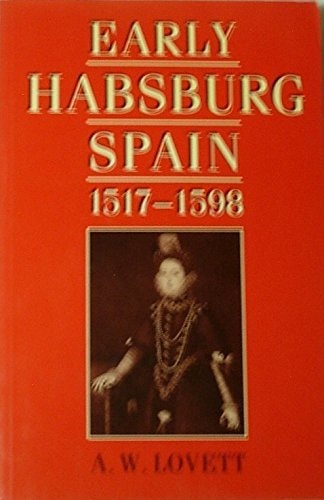
Early Habsburg Spain 1517-1598
0
0
As an Amazon Associate and affiliate partner, Menrva Books earns from qualifying purchases. Learn more
Author Description
During the 16th century Philip II and Charles V transformed the kingdom of Castile into a world power, which sought to maintain its leading position in Europe while consolidating its empire abroad and establishing a Catholic society at home. Using recent advances in Spanish historiography previously unavailable to English readers, Lovett examines familiar topics such as the conquests of Mexico and Peru, the revolt of the Netherlands, the Armada, and the Inquisition, while also taking a close look at new themes such as regional differences within the Iberian peninsula and conflicts with the unassimilated Jewish population. The profound economic consequences of the new transatlantic colonies are also fully discussed in this lively and lucid account of 16th-century Spain.
Menrva's Summary
THE THESIS
This book investigates how the Habsburg monarchs Charles V and Philip II navigated the complex geopolitical, religious, and economic challenges of 16th-century Spain to establish a global power. A. W. Lovett utilizes contemporary Spanish historiography to provide a comprehensive analysis of the administrative and social structures of the era. The text argues that the consolidation of the Spanish empire was a multifaceted process involving internal religious homogenization, colonial expansion, and the management of diverse regional interests across the Iberian peninsula.
THE SCOPE MAP
What You Will Find
- Analysis of the political and economic impact of the colonization of Mexico and Peru.
- Examination of the religious and social tensions involving the Inquisition and unassimilated populations.
- Discussion of the military and diplomatic conflicts including the revolt of the Netherlands and the Spanish Armada.
- Exploration of regional administrative differences within the Iberian peninsula during the Habsburg reign.
THE AUTHORITY PERSPECTIVE
Historians and students of the period frequently cite this work as a balanced and accessible synthesis of 16th-century Spanish history. Experts highlight the author's ability to integrate complex historiographical shifts into a clear narrative framework for English-speaking readers.
Page Count:
300
Publication Date:
1986-12-04
Publisher:
Oxford University Press
ISBN-10:
019822138X
ISBN-13:
9780198221388
History
Politics & Government
Political History
Spanish History
European History
Spain history
Community Tags
Similar Books