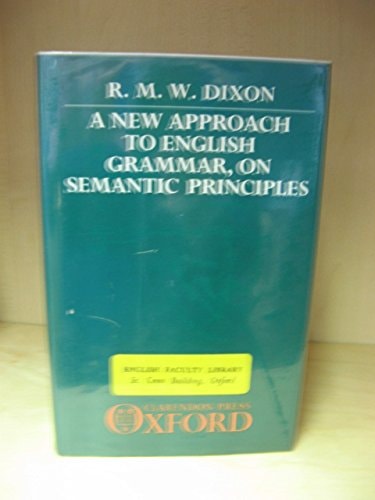
A New Approach to English Grammar, on Semantic Principles
0
0
As an Amazon Associate and affiliate partner, Menrva Books earns from qualifying purchases. Learn more
Author Description
This work offers a fresh approach to grammar, arguing that a speaker "codes" a meaning into grammatical forms in order to communicate them to a hearer. Investigating the interrelation of grammar and meaning, Dixon uncovers a rationale for the varying grammatical properties of different words. He offers a review of some of the main points of English syntax, as well as a discussion of English verbs in terms of semantic types. Finally, he examines five specific grammatical topics: complement clauses in detail; complement clauses, transitivity and causatives; passive construction; promotion of a non-subject to subject slot; and the relation between verb constructions.
Menrva's Summary
THE THESIS
This work investigates the core question of how grammatical forms in English are fundamentally rooted in semantic meaning rather than arbitrary rules. R. M. W. Dixon, a prominent linguist, utilizes his extensive background in typological research to argue that speakers encode meaning into specific grammatical structures. He presents a framework where the grammatical properties of words are explained through their semantic types, challenging traditional prescriptive approaches to syntax.
THE SCOPE MAP
What You Will Find
- A semantic classification of English verbs based on their underlying meaning types.
- An analysis of complement clauses and their role in sentence construction.
- A detailed examination of transitivity, causatives, and passive voice structures.
- A methodology for understanding how non-subject elements are promoted to subject positions.
THE AUTHORITY PERSPECTIVE
Linguists and students of syntax frequently cite this text as a foundational resource for understanding the semantic basis of English grammar. Experts highlight the clarity of Dixon's arguments, noting that the book provides a rigorous alternative to purely formalist approaches to language study.
Page Count:
416
Publication Date:
1991-02-28
Publisher:
Oxford University Press
ISBN-10:
0198242727
ISBN-13:
9780198242727
Non-Fiction
Linguistics
Reference
Education
Language and linguistics
Grammar
English language semantics
Community Tags
Similar Books