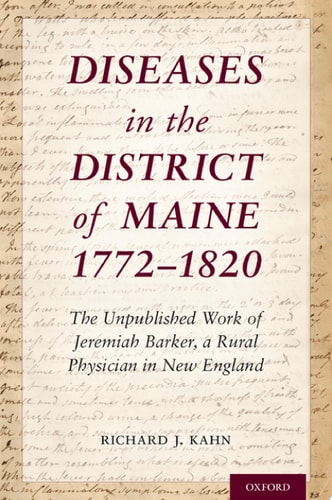
Diseases in the District of Maine 1772-1820
0
0
As an Amazon Associate and affiliate partner, Menrva Books earns from qualifying purchases. Learn more
Author Description
Jeremiah Barker Practiced Medicine In Rural Maine Up Until His Retirement In 1818. Throughout His Practice Of Fifty Years, He Documented His Constant Efforts To Keep Up With And Contribute To The Medical Literature In A Changing Medical Landscape, As Practice And Authority Shifted From Historical To Scientific Methods. He Performed Experiments And Autopsies, Became Interested In The New Chemistry Of Lavoisier, Risked Scorn In His Use Of Alkaline Remedies, Studied Epidemic Fever And Approaches To Bloodletting, And Struggled To Understand Epidemic Fever, Childbed Fever, Cancer, Public Health, Consumption, Mental Illness, And The Dangers Of Spirituous Liquors. Dr. Barker Intended To Publish His Diseases In The District Of Maine 1772-1820 By Subscription - Advance Pledges To Purchase The Published Volume - But For Reasons That Remain Uncertain, That Never Happened. For The First Time, Barker's Never Before Published Work Has Been Transcribed And Presented In Its Entirety With Extensive Annotations, A Five-chapter Introduction To Contextualize The Work, And A Glossary To Make It Accessible To 21st Century General Readers, Genealogists, Students, And Historians. This Engaging And Insightful New Publication Allows Modern Readers To Reimagine Medicine As Practiced By A Rural Physician In New England. We Know Much About How Elite Physicians Practiced 200 Years Ago, But Very Little About The Daily Practice Of An Ordinary Rural Doctor, Attending The Ordinary Rural Patient. Barker's Manuscript Is Written In A Clear And Engaging Style, Easily Enjoyed By General Readers As Well As Historians, With Extensive Footnotes And A Glossary Of Terms. Barker Himself Intended His Book To Be Understood By Those Destitute Of Medical Science.
Menrva's Summary
THE THESIS
This work investigates the daily medical practices and observations of rural physician Jeremiah Barker in Maine between 1772 and 1820. Author Richard J. Kahn presents a transcription of Barker's unpublished manuscript, contextualizing the transition from historical medical traditions to early scientific methodologies. The book argues that Barker's documentation provides a rare, granular view of rural healthcare that contrasts with the well-documented practices of elite urban physicians of the era.
THE SCOPE MAP
What You Will Find
- A complete transcription of Jeremiah Barker's original medical manuscript.
- Analysis of 18th and 19th-century treatments for epidemic fever, consumption, and mental illness.
- A five-chapter introduction providing historical context for the medical landscape of rural New England.
- A comprehensive glossary of period-specific medical terminology.
Scope Limits
- The text is limited to the observations and experiences of a single rural practitioner.
- It does not provide a comprehensive survey of national medical policy during the period.
THE AUTHORITY PERSPECTIVE
Historians and genealogists value this text as a primary source for understanding the practical realities of early American medicine. Readers frequently note the accessibility of the prose, which remains clear despite the technical nature of the medical observations.
Page Count:
240
Publication Date:
2020-01-01
Publisher:
Oxford University Press
ISBN-10:
0190053267
ISBN-13:
9780190053260
History
Biography
New England
18th century
MEDICAL History
19th Century
Medicine
Community Tags
Similar Books