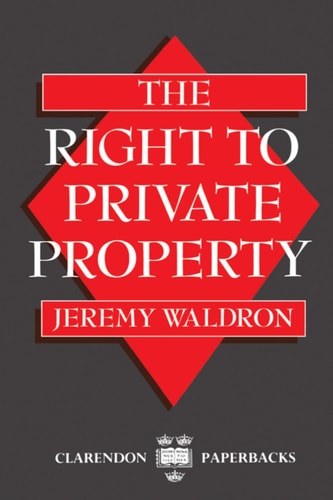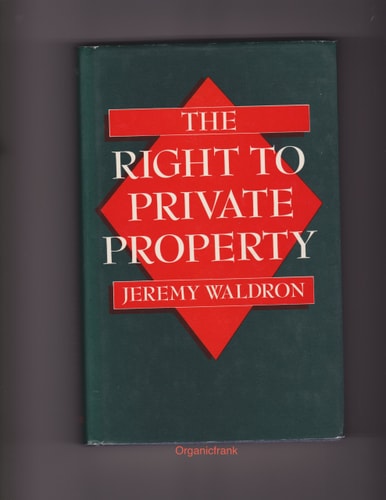
The Right to Private Property
0
0
As an Amazon Associate and affiliate partner, Menrva Books earns from qualifying purchases. Learn more
Author Description
Presenting a comprehensive, critical examination of the claim that private property is one of the fundamental rights of humankind, Waldron here contrasts two types of arguments about rights: those based on historical entitlement, and those based on the importance of property for freedom. He illustrates this contrast with a detailed discussion of the theories of property found in Locke's Second Treatise and Hegel's Philosophy of Rights, and offers original analyses of the concept of ownership, the idea of rights, and the relation between property and equality, finding that traditional arguments about property yield some surprisingly radical conclusions.
Menrva's Summary
THE THESIS
This work investigates whether private property constitutes a fundamental human right by critically evaluating the philosophical foundations of ownership. Jeremy Waldron, a prominent legal and political philosopher, examines the tension between historical entitlement and the functional role of property in securing individual freedom. By analyzing classical texts and modern concepts, he constructs a rigorous framework to determine if the traditional justification for property rights remains logically consistent when applied to contemporary social structures.
THE SCOPE MAP
What You Will Find
- Comparative analysis of John Locke’s entitlement theory and G.W.F. Hegel’s freedom-based property theory.
- Conceptual breakdown of the legal and moral definitions of ownership.
- Examination of the intersection between private property rights and social equality.
- Critical assessment of how traditional property arguments lead to radical political conclusions.
THE AUTHORITY PERSPECTIVE
Scholars and legal theorists frequently cite this text as a foundational contribution to the study of property rights and political philosophy. Readers often note the high level of academic density and the precise, analytical rigor applied to complex ethical arguments.
Page Count:
480
Publication Date:
1989-02-09
Publisher:
Oxford University Press
ISBN-10:
0198249594
ISBN-13:
9780198249597
Philosophy
Economics
Law
Political Theory