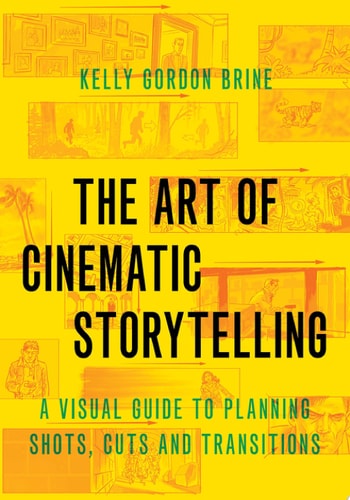
The Art of Cinematic Storytelling: A Visual Guide to Planning Shots, Cuts, and Transitions
0
0
As an Amazon Associate and affiliate partner, Menrva Books earns from qualifying purchases. Learn more
Author Description
To dramatize a story using moving images, a director must have a full understanding of the meaning and emotional effect of all the various types of shots and cuts that are available to advance the story. Drawing upon his extensive experience as a storyboard artist who has worked with over 200 directors and cinematographers on television series and movies, author Kelly Gordon Brine provides a practical and accessible introduction to the design of shots, cuts, and transitions for film, television, animation, video, and game design.With hundreds of illustrations and diagrams, concise explanations of essential storytelling concepts, and vivid examples, The Art of Cinematic Storytelling demystifies the visual design choices that are fundamental to directing and editing. The author delves deeply into the techniques that visual storytellers use to captivate their audience, including blocking, camera positioning, transitions, and planning shots with continuity editing in mind. Practical advice on how to clarify time, space, and motion in many common situations — such as dialogue, pursuits, and driving sequences — makes this book an invaluable guide for all aspiring filmmakers.
Menrva's Summary
THE THESIS
This book investigates the fundamental visual language of cinema, specifically how shot selection, camera positioning, and editing transitions function to convey narrative meaning and emotional impact. Author Kelly Gordon Brine, a veteran storyboard artist with experience across hundreds of film and television productions, utilizes his professional background to synthesize complex visual design principles into a practical framework. He argues that effective visual storytelling requires a deliberate, technical approach to blocking and continuity that transcends mere aesthetic choice.
THE SCOPE MAP
What You Will Find
- Technical analysis of camera positioning and blocking techniques
- Methodologies for planning shots to maintain spatial and temporal continuity
- Instructional diagrams for common sequences including dialogue and pursuit scenes
- Principles of transition design for film, television, and animation
Scope Limits
- The text focuses primarily on visual planning and storyboard-adjacent techniques rather than post-production color grading or sound design
- It does not cover the business or legal aspects of film production
THE AUTHORITY PERSPECTIVE
Industry professionals and students frequently cite this work as a highly accessible entry point for understanding the mechanics of visual continuity. Experts highlight the book's reliance on clear, illustrative diagrams as a primary strength for those learning to translate written scripts into visual sequences.
Page Count:
355
Publication Date:
2020-01-01
Publisher:
Oxford University Press
ISBN-10:
0190054352
ISBN-13:
9780190054359
Directing
Film
Film Production
Cinematography
Video photography
Reference
Video
Graphic Design
Humor & Entertainment
Film Editing
Screenwriting
Television
New Used & Rental Textbooks
Movies
Animation
Direction & Production
Writing for Radio Television & Film
Community Tags
Similar Books