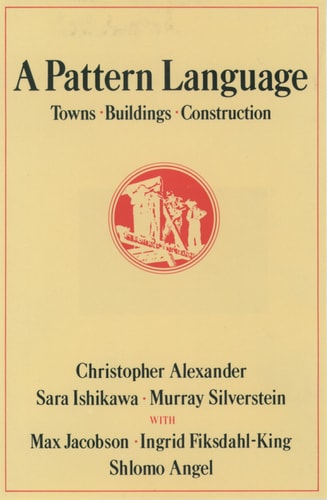
A Pattern Language: Towns, Buildings, Construction
0
0
As an Amazon Associate and affiliate partner, Menrva Books earns from qualifying purchases. Learn more
Author Description
You can use this book to design a house for yourself with your family; you can use it to work with your neighbors to improve your town and neighborhood; you can use it to design an office, or a workshop, or a public building. And you can use it to guide you in the actual process of construction. After a ten-year silence, Christopher Alexander and his colleagues at the Center for Environmental Structure are now publishing a major statement in the form of three books which will, in their words, "lay the basis for an entirely new approach to architecture, building and planning, which will we hope replace existing ideas and practices entirely." The three books are The Timeless Way of Building, The Oregon Experiment, and this book, A Pattern Language. At the core of these books is the idea that people should design for themselves their own houses, streets, and communities. This idea may be radical (it implies a radical transformation of the architectural profession) but it comes simply from the observation that most of the wonderful places of the world were not made by architects but by the people. At the core of the books, too, is the point that in designing their environments people always rely on certain "languages," which, like the languages we speak, allow them to articulate and communicate an infinite variety of designs within a forma system which gives them coherence. This book provides a language of this kind. It will enable a person to make a design for almost any kind of building, or any part of the built environment. "Patterns," the units of this language, are answers to design problems (How high should a window sill be? How many stories should a building have? How much space in a neighborhood should be devoted to grass and trees?). More than 250 of the patterns in this pattern language are given: each consists of a problem statement, a discussion of the problem with an illustration, and a solution.
Menrva's Summary
THE THESIS
This book investigates the fundamental question of how individuals can reclaim the design of their own built environments through a shared, human-centric architectural language. Christopher Alexander and his colleagues at the Center for Environmental Structure argue that the most successful human spaces are created by the people who inhabit them rather than professional architects. They propose a system of 253 interconnected patterns that serve as a practical, modular framework for designing everything from individual rooms to entire towns and regional landscapes.
THE SCOPE MAP
What You Will Find
- A collection of 253 distinct design patterns addressing problems at the scale of towns, buildings, and construction.
- A methodology for combining patterns to create coherent, functional, and human-scaled environments.
- Illustrations and problem-solution statements for each pattern.
Scope Limits
- The text does not provide modern building code compliance or specific engineering calculations for structural integrity.
- It does not focus on high-rise urban density or industrial-scale commercial development.
THE AUTHORITY PERSPECTIVE
Experts and practitioners widely recognize this work as a foundational text in urban design and participatory architecture. Readers frequently note the density of the prose and the philosophical depth of the patterns, which continue to influence modern sustainable design and community planning.
Page Count:
1172
Publication Date:
2018-01-01
Publisher:
Oxford University Press
ISBN-10:
0190050357
ISBN-13:
9780190050351
Architecture
Design & Architecture
Construction
Sociology
Criticism
ARCHITECTURE Criticism
urban planning
Design
Community Tags
Similar Books