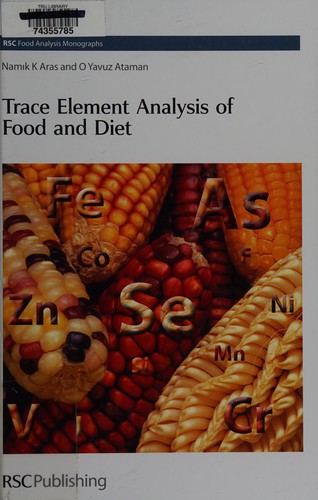
Trace Element Analysis of Food and Diet
0
0
As an Amazon Associate and affiliate partner, Menrva Books earns from qualifying purchases. Learn more
Author Description
Trace element analysis has a key role to play in quality control of food and diet. This timely book introduces the subject in a practical way - from sampling and the techniques available for trace analysis, to procedures for specific elements and data analysis. Beginning with a brief introduction and discussion of statistical evaluation of data, the subsequent chapter looks at trace analysis in general, with its essentials and terminology. Another section introduces sampling and preparation of foodstuffs such as wheat, potato, vegetables and milk. This is followed by descriptions of the various spectrometric techniques (atomic absorption, atomic emission, atomic fluorescence) that are available. Plasma techniques for both optical emission and mass spectrometry are presented, as are nuclear activation analysis and X-ray methods. A comparison of the various analytical techniques is provided, and a separate chapter handles speciation analysis. Finally, procedures for determining essential and toxic elements such as arsenic, iron, selenium and zinc are suggested, using several recent references. Detailed explanations and a simple format will appeal to laboratory technicians and graduate students, as well as more experienced researchers. Comprehensive coverage, coupled with illustrations and a guide to relevant literature and manufacturers, will make Trace Element Analysis of Food and Diet a valuable source of information for anyone working on analysis of trace elements in food, diet or other biological or environmental samples - particularly food engineers, agricultural scientists and government testing agency employees.
Menrva's Summary
THE THESIS
This book addresses the critical role of trace element analysis in ensuring the quality and safety of food and dietary products. The author, Namık K. Aras, provides a practical guide covering the entire analytical process, from initial sampling and preparation of various foodstuffs to the application of diverse spectrometric and nuclear techniques. It aims to equip laboratory technicians, graduate students, and experienced researchers with the knowledge to analyze essential and toxic elements, understand speciation, and interpret data effectively within the context of food and environmental science.
THE SCOPE MAP
- Introduction to trace element analysis and statistical evaluation of data.
- General principles, essentials, and terminology of trace analysis.
- Sampling and preparation procedures for foodstuffs including wheat, potato, vegetables, and milk.
- Detailed descriptions of spectrometric techniques: Atomic Absorption, Atomic Emission, and Atomic Fluorescence.
- Explanation of Plasma techniques: Optical Emission Spectrometry (OES) and Mass Spectrometry (MS).
- Coverage of Nuclear Activation Analysis and X-ray methods.
- Comparison of various analytical techniques.
- Discussion of speciation analysis and procedures for determining essential (e.g., iron, zinc) and toxic (e.g., arsenic, selenium) elements.
THE AUTHORITY PERSPECTIVE
The book is designed to be a valuable resource for professionals and students working with trace element analysis in food, diet, and related biological or environmental samples. Its comprehensive coverage, practical approach, and inclusion of illustrations and literature references are intended to make it accessible and useful for food engineers, agricultural scientists, and government testing agency employees. The detailed explanations and simple format are geared towards a broad audience, from technicians to experienced researchers. It aims to serve as a key reference for understanding and applying analytical methods in food quality control.
Page Count:
344
Publication Date:
2006-01-01
ISBN-10:
0854045767
ISBN-13:
9780854045761
Science
Non-Fiction
Food Science
Analytical Chemistry
Community Tags
Similar Books