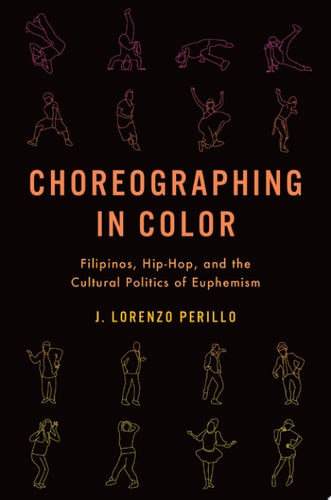
Choreographing in Color: Filipinos, Hip-Hop, and the Cultural Politics of Euphemism
0
0
As an Amazon Associate and affiliate partner, Menrva Books earns from qualifying purchases. Learn more
Author Description
In Choreographing in Color, J. Lorenzo Perillo investigates the development of Filipino popular dance and performance since the late 20th century. Drawing from nearly two decades of ethnography, choreographic analysis, and community engagement with artists, choreographers, and organizers, Perillo shifts attention away from the predominant Philippine neoliberal and U.S. imperialist emphasis on Filipinos as superb mimics, heroic migrants, model minorities, subservient wives, and natural dancers and instead asks: what does it mean for Filipinos to navigate the violent forces of empire and neoliberalism with street dance and Hip-Hop?Employing critical race, feminist, and performance studies, Perillo analyzes the conditions of possibility that gave rise to Filipino dance phenomena across viral, migrant, theatrical, competitive, and diplomatic performance in the Philippines and diaspora. Advocating for serious engagements with the dancing body, Perillo rethinks a staple of Hip-Hop's regulation, the "euphemism," as a mode of social critique for understanding how folks have engaged with both racial histories of colonialism and gendered labor migration. Figures of euphemism - the zombie, hero, robot, and judge - constitute a way of seeing Filipino Hip-Hop as contiguous with a multi-racial repertoire of imperial crossing, thus uncovering the ways Black dance intersects Filipino racialization and reframing the ongoing, contested underdog relationship between Filipinos and U.S. global power. Choreographing in Color therefore reveals how the Filipino dancing body has come to be, paradoxically, both globally recognized and indiscernible.
Menrva's Summary
THE THESIS
How do Filipino dancers navigate the violent intersections of empire and neoliberalism through the medium of Hip-Hop and street dance? J. Lorenzo Perillo, a scholar in performance studies, utilizes nearly two decades of ethnographic research and choreographic analysis to challenge traditional narratives of Filipinos as merely natural performers or model minorities. The book argues that dance serves as a critical site for social critique, where the body acts as a vessel for processing colonial history and gendered labor migration.
THE SCOPE MAP
What You Will Find
- Analysis of Filipino dance phenomena across viral, migrant, theatrical, and competitive platforms.
- A theoretical framework utilizing the concept of the 'euphemism' to decode dance movements.
- Examination of the intersection between Black dance traditions and Filipino racialization.
Scope Limits
- The text does not provide a comprehensive history of all Philippine dance forms, focusing specifically on Hip-Hop and street dance.
- It does not offer a general guide to dance technique, prioritizing cultural and political analysis over instructional content.
THE AUTHORITY PERSPECTIVE
Scholars in the fields of performance and ethnic studies recognize this work as a significant contribution to the understanding of the Filipino diaspora and global Hip-Hop culture. Readers frequently note the academic density of the prose, which requires a foundational understanding of critical race and postcolonial theory to fully engage with the author's arguments.
Page Count:
272
Publication Date:
2020-09-08
Publisher:
Oxford University Press
ISBN-10:
0190054271
ISBN-13:
9780190054274
Politics
Hip-hop
New Used & Rental Textbooks
Dance
Ethnic Studies
Performance Studies
Sociology
Community Tags
Similar Books