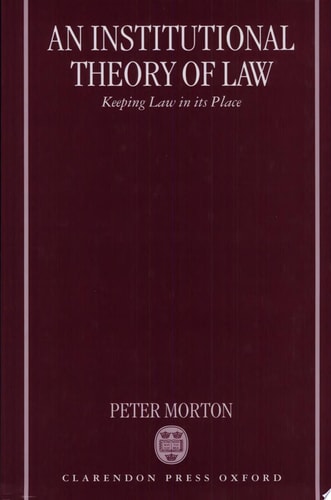
An Institutional Theory of Law: Keeping Law in Its Place
0
0
As an Amazon Associate and affiliate partner, Menrva Books earns from qualifying purchases. Learn more
Author Description
Peter Morton provides in these pages a fundamental critique of the assumptions of positivist jurisprudence and also puts forth an attack on the foundationalism of contemporary legal philosophy. His prime concern is to distinguish between the different fields of law--penal, civil, and public--taking as his starting point a careful analysis of those institutions in a democracy wherein legal language and norms are in fact generated. Offering an original, coherent, and systematic exposition of law in today's society, Morton sheds new light on legal practices and relations by way of a comparison with an ideal type of legal system.
Menrva's Summary
THE THESIS
How can legal institutions be accurately categorized and understood within the framework of a modern democratic society? Peter Morton, a scholar of legal theory, challenges the prevailing assumptions of positivist jurisprudence and the foundationalist tendencies of contemporary legal philosophy. By analyzing the distinct functions of penal, civil, and public law, Morton constructs a systematic exposition that differentiates legal norms based on their institutional origins. His argument centers on the necessity of maintaining clear boundaries between these legal fields to preserve the integrity of the democratic system.
THE SCOPE MAP
What You Will Find
- A comparative analysis of penal, civil, and public law structures.
- A critique of positivist jurisprudence and foundationalist legal theory.
- An institutional framework for understanding how legal norms are generated in democracies.
- A model of an ideal legal system used as a benchmark for evaluating current practices.
THE AUTHORITY PERSPECTIVE
Legal scholars frequently cite this work as a rigorous challenge to traditional positivist interpretations of law. The text is noted for its high level of academic density and its systematic approach to institutional classification.
Page Count:
432
Publication Date:
1998-04-23
Publisher:
Oxford University Press
ISBN-10:
0198258259
ISBN-13:
9780198258254
Non-Fiction
Law
Law Philosophy
Jurisprudence