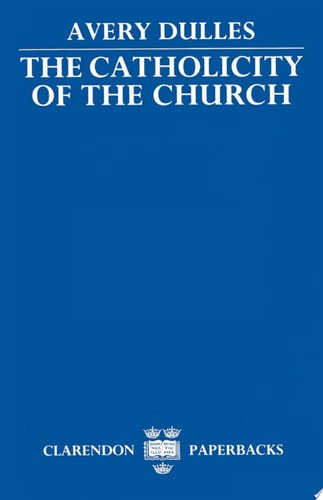
The Catholicity of the Church
0
0
As an Amazon Associate and affiliate partner, Menrva Books earns from qualifying purchases. Learn more
Author Description
Avery Dulles, well-known for several previous works in ecclesiology, including Models of the Church, here surveys a theme that demands new treatment in the present global and ecumenical context. Nearly all Christians profess allegiance to the holy catholic church, but the meaning of the term "catholic" is widely disputed. This book investigates the historical use of the word and the various aspects of catholicity. Beginning with the word's divine source in Christ as "the first-born of all creation," Dulles goes on to discuss such topics as the "catholic principle," Catholicism as a specific ecclesial type, and the possibility of a "Protestant Catholicism." He concludes by asking how, given the current "parochial" appearance of Christianity, any Christian church can plausibly claim to be catholic.
Menrva's Summary
THE THESIS
This book investigates the historical, theological, and ecumenical significance of the term "catholic" as it pertains to the identity and mission of the Christian church. Avery Dulles, a prominent theologian and Jesuit priest, utilizes his extensive background in ecclesiology to examine how the concept of catholicity has evolved from its origins in Christ to its contemporary application. He provides a rigorous framework for understanding the "catholic principle" and addresses the tension between the universal claims of the church and the reality of its fragmented, parochial existence in the modern world.
THE SCOPE MAP
What You Will Find
- Historical analysis of the term "catholic" from early Christian origins to the present day.
- Theological exploration of the "catholic principle" and its role in defining ecclesial identity.
- Examination of the potential for a "Protestant Catholicism" within ecumenical discourse.
- Critical assessment of how modern Christian denominations reconcile their specific traditions with the claim of universal catholicity.
THE AUTHORITY PERSPECTIVE
Experts recognize this work as a significant contribution to the field of ecclesiology, particularly for its nuanced approach to ecumenical dialogue. Readers frequently note the academic density of the prose, which serves as a foundational text for those studying the intersection of church history and systematic theology.
Page Count:
208
Publication Date:
1987-12-03
Publisher:
Clarendon Press
ISBN-10:
0198266952
ISBN-13:
9780198266952
Religion
Catholicism
Christianity
Ecclesiology
Theology
Community Tags
Similar Books