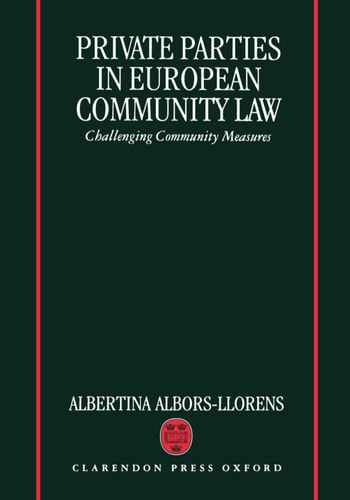
Private Parties in European Community Law: Challenging Community Measures
0
0
As an Amazon Associate and affiliate partner, Menrva Books earns from qualifying purchases. Learn more
Author Description
The European Community legislative process is still characterized by a certain lack of democracy, even after the Maastricht amendments to the European Community Treaties. It is therefore a matter of great importance that there is an adequate system of judicial review of community acts which will enable private parties to challenge illegal, invalid and unfair community administrative actions. There thus exists a system by which private parties can bring direct and indirect actions to seek redress. The direct actions are the actions for annulment and the action for a failure to act. The indirect action is the plea of illegality. In addition to this system specifically designed to assess the legality of community measures there are two other remedies not intended for this purpose but which are used to effect a consideration of the legality of a certain act: these are preliminary rulings on the validity of acts of the Institutions and actions for damages.The book is divided into two parts. The first part deals extensively with annulment proceedings. The drafters of the EC Treaty attached severe conditions of locus standi to this remedy and it has fallen to the European Court of Justice to interpret and apply these conditions through its Case Law. Commentators have found it difficult to discern a common trend in the approach of the court to the locus standi issue. It appears clear however that the court has followed a very restrictive approach and that many actions have been dismissed as inadmissible. The author of this work re-examines the Case Law and systematizes it to highlight specific areas (particularly anti-dumping, competition and state aids cases) and to a lesser extent in the area of general management of the market where there has evolved a more lenient approach to the determination of the issue of locus standi of natural and legal persons.The second part of the book deals with the alternative means of review (ie via an Article 177 Treaty reference) and sugge
Menrva's Summary
THE THESIS
This book investigates the adequacy and accessibility of judicial review mechanisms within European Community law for private parties seeking to challenge administrative measures. Albertina Albors-Llorens, an expert in European Union law, provides a rigorous examination of the legal frameworks governing direct and indirect actions against Community institutions. By analyzing the restrictive locus standi requirements established by the European Court of Justice, the author evaluates how private individuals and legal entities navigate the complexities of seeking redress for invalid or unfair administrative actions.
THE SCOPE MAP
What You Will Find
- A comprehensive analysis of annulment proceedings and the failure to act as primary direct legal remedies.
- An examination of indirect remedies, including the plea of illegality, preliminary rulings, and actions for damages.
- A systematic review of European Court of Justice case law across specific sectors such as anti-dumping, competition, and state aids.
- A critical assessment of the evolution of locus standi standards for natural and legal persons within the European legal system.
THE AUTHORITY PERSPECTIVE
Legal scholars and practitioners identify this work as a significant contribution to the understanding of judicial review in the European context. Readers frequently note the academic density of the prose and the author's precise categorization of complex case law trends.
Page Count:
312
Publication Date:
1996-08-29
Publisher:
Clarendon Press
ISBN-10:
0198260806
ISBN-13:
9780198260806
European Law
Law
Administrative Law
Reference
Law europe
Community Tags
Similar Books