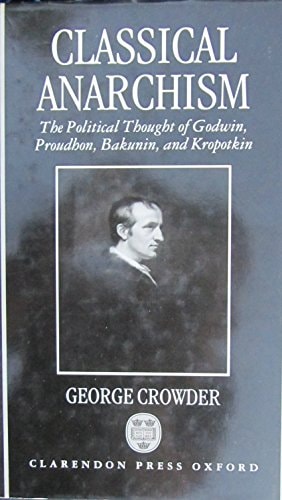
Classical Anarchism: The Political Thought of Godwin, Proudhon, Bakunin, and Kropotkin
0
0
As an Amazon Associate and affiliate partner, Menrva Books earns from qualifying purchases. Learn more
Author Description
How can there be order in a modern society without government? In Classical Anarchism, George Crowder considers the presentation of stateless order in the works of writers who epitomized the "classical" tradition of anarchistic thought--Godwin, Proudhon, Kropotkin, and Bakunin. Crowder argues that their theses of stateless order are more coherent and persuasive than usually supposed if considered in their intellectual and historical context. He concentrates on three aspects of anarchist thought which have been previously neglected or misunderstood: the "positive" character of their concept of freedom, the complexity of their responses to Rousseau, and the degree to which they were influenced by contemporary scientism. Crowder closes with an evaluation of classical anarchism from a current perspective and considers prospects for the future of anarchist ideology.
Menrva's Summary
THE THESIS
How can a modern society maintain order without the presence of a centralized government? George Crowder, a scholar of political theory, examines the foundational works of Godwin, Proudhon, Bakunin, and Kropotkin to argue that their visions of stateless order are intellectually robust when analyzed within their specific historical and scientific contexts. By addressing the nuances of their concepts of freedom and their engagement with Enlightenment thinkers, Crowder challenges the common dismissal of these figures as mere utopian dreamers.
THE SCOPE MAP
What You Will Find
- Historical analysis of the intellectual development of classical anarchist thought.
- Examination of the influence of 19th-century scientism on anarchist political frameworks.
- Comparative study of the anarchist response to Jean-Jacques Rousseau.
- Evaluation of the long-term viability and contemporary relevance of anarchist ideology.
THE AUTHORITY PERSPECTIVE
Scholars and students of political philosophy frequently cite this work as a necessary corrective to the superficial interpretations of anarchist theory. Experts highlight the book's ability to bridge the gap between historical context and modern political application.
Page Count:
224
Publication Date:
1992-01-23
Publisher:
Oxford University Press
ISBN-10:
019827744X
ISBN-13:
9780198277446
History
Philosophy
Political Theory
Anarchism
Community Tags
Similar Books