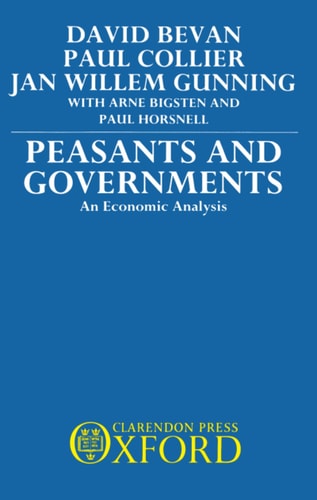
Peasants and Governments: An Economic Analysis
0
0
As an Amazon Associate and affiliate partner, Menrva Books earns from qualifying purchases. Learn more
Author Description
The first of two companion volumes on trade shocks in controlled economies, the authors here address the relationship between micro and macroeconomics through analysis of an external macro shock--the coffee price boom--on two developing countries whose similarities end at the level of governmental organization and objectives. Using microeconomic analysis and household survey data, they focus on crop prices, access to consumer goods, and provision of public services in Kenya and Tanzania.
Menrva's Summary
THE THESIS
This work investigates how disparate governmental structures influence the transmission of external macroeconomic shocks to the microeconomic level within developing nations. The authors, David Bevan, Jan Willem Gunning, and Paul H. Collier, utilize a comparative framework to examine the coffee price boom of the 1970s. By contrasting the economic policies of Kenya and Tanzania, the text evaluates how varying state objectives and organizational capacities dictate the welfare of rural populations and the distribution of public resources.
THE SCOPE MAP
What You Will Find
- Comparative analysis of economic policy responses in Kenya and Tanzania.
- Microeconomic modeling of household behavior in response to commodity price fluctuations.
- Integration of household survey data to track access to consumer goods and public services.
- Theoretical framework linking macro-level trade shocks to micro-level agricultural outcomes.
THE AUTHORITY PERSPECTIVE
Experts recognize this volume as a foundational study in the field of development economics for its rigorous application of microeconomic theory to national policy analysis. Scholars frequently cite the text for its detailed empirical approach to understanding the impact of state intervention on rural economic stability.
Page Count:
368
Publication Date:
1990-03-08
Publisher:
Clarendon Press
ISBN-10:
019828621X
ISBN-13:
9780198286219
Economics
Microeconomics
Macroeconomics
Peasants
Community Tags
Similar Books