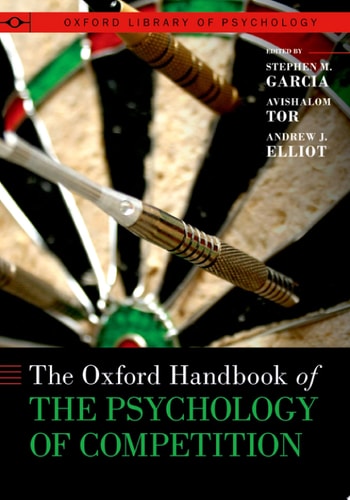
The Oxford Handbook of the Psychology of Competition
0
0
As an Amazon Associate and affiliate partner, Menrva Books earns from qualifying purchases. Learn more
Author Description
In The Oxford Handbook of the Psychology of Competition, Stephen M. Garcia, Avishalom Tor, and Andrew J. Elliot review and organize the literature on the psychology of competition and bring together leading researchers studying competition across the field of psychology. The first section on Biological Approaches reviews findings on competition from the subfields of psychobiology, neuroscience, psycho-endocrinology, and evolutionary psychology. The section on Motivational and Emotional Approaches examines the opposing motivational forces in competition and describes how competitive motivation is influenced by goals, competitive arousal, and envy. Cognitive and Decision-Making Approaches showcases relevant findings from the literature on judgment and decision making, social dilemmas, cognitive biases, and risk-taking. The section on Social-Personality and Organizational Approaches includes chapters on trait competitiveness, gender differences in competition, rivalry, status competition, and social comparison. The volume concludes with a section in which the psychological study of competition is focused on specific contexts, such as sports, education, and culture. The Oxford Handbook of the Psychology of Competition is a crucial interdisciplinary investigation into the variety of perspectives and approaches to the psychology of competition, facilitating new research and integration in the field.
Menrva's Summary
THE THESIS
This volume investigates the multifaceted psychological mechanisms that drive competitive behavior across diverse human domains. The editors, Andrew J. Elliot, Avishalom Tor, and Stephen M. Garcia, curate contributions from leading researchers to synthesize existing literature. The text establishes a comprehensive framework that bridges biological, cognitive, and social-personality perspectives to explain why and how individuals engage in competition.
THE SCOPE MAP
What You Will Find
- Biological foundations including neuroscience and psycho-endocrinology
- Analysis of motivational forces such as envy and goal-setting
- Cognitive frameworks regarding risk-taking and decision-making biases
- Social-personality factors like trait competitiveness and status seeking
- Contextual applications in sports, education, and cultural environments
Scope Limits
- Does not provide practical self-help strategies for personal competition
- Focuses primarily on psychological research rather than sociological or economic theory
THE AUTHORITY PERSPECTIVE
Experts identify this work as a foundational reference for researchers and graduate students in the behavioral sciences. Readers frequently note the academic density of the prose and the rigorous, evidence-based approach taken by the contributors.
Page Count:
688
Publication Date:
2024-01-01
Publisher:
Oxford University Press
ISBN-10:
0190060808
ISBN-13:
9780190060800
Psychology
Psychology
Education & Training
Schools & Teaching
Medical Books
Education Teaching
Reference
Academic
Counseling Psychology
Behavioral Science
Community Tags
Similar Books