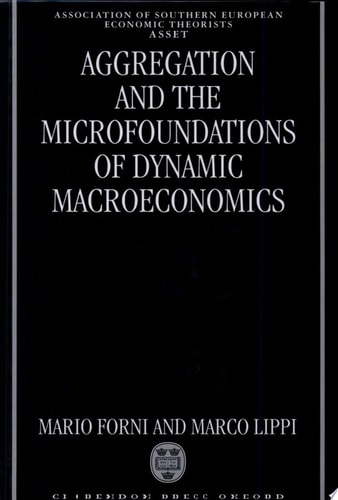
Aggregation and the Microfoundations of Dynamic Macroeconomics
0
0
As an Amazon Associate and affiliate partner, Menrva Books earns from qualifying purchases. Learn more
Author Description
Through careful methodological analysis, this book argues that modern macroeconomics has completely overlooked the aggregate nature of the data. In Part I, the authors test and reject the homogeneity assumption using disaggregate data. In Part II, they demonstrate that apart from random flukes, cointegration unidirectional Granger causality and restrictions on parameters do not survive aggregation when heterogeneity is introduced. They conclude that the claim that modern macroeconomics has solid microfoundations is unwarranted. However, some important theory-based models that do not fit aggregate data well in their representative-agent version can be reconciled with aggregate data by introducing heterogeneity.
Menrva's Summary
THE THESIS
This book investigates whether modern macroeconomic models possess valid microfoundations by analyzing the impact of data aggregation on economic theory. The authors, Marco Lippi and Mario Forni, utilize rigorous econometric methodology to challenge the representative-agent framework. They argue that the assumption of homogeneity in aggregate data is fundamentally flawed and that standard macroeconomic conclusions often fail to survive when heterogeneity is properly accounted for in the analysis.
THE SCOPE MAP
What You Will Find
- Methodological analysis of disaggregate versus aggregate data sets
- Statistical testing of the homogeneity assumption in macroeconomic modeling
- Mathematical proofs regarding cointegration and Granger causality under aggregation
- Theoretical frameworks for reconciling representative-agent models with heterogeneous data
THE AUTHORITY PERSPECTIVE
Experts in the field recognize this text as a critical technical challenge to standard macroeconomic modeling practices. Readers frequently note the high level of mathematical density and the specialized nature of the econometric arguments presented throughout the work.
Page Count:
256
Publication Date:
1998-02-12
Publisher:
Clarendon Press
ISBN-10:
019828800X
ISBN-13:
9780198288008
Economics
Mathematical Economics
Econometrics
Macroeconomics
Academic
Community Tags
Similar Books