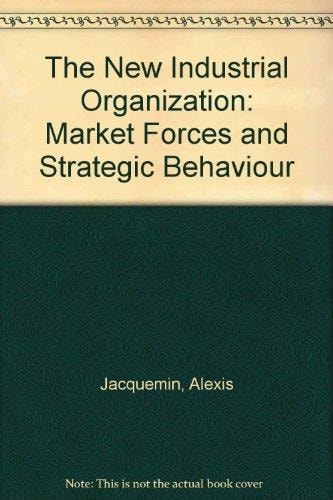
The New Industrial Organization
0
0
As an Amazon Associate and affiliate partner, Menrva Books earns from qualifying purchases. Learn more
Author Description
This timely book surveys and illuminates the recent literature on industrial organization by contrasting the analyses based on the idea of "natural" adaptation of industry to environmental conditions and those that focus on the "strategic" dimension and manipulation of environment. Among the topics dealt with are the sociobiology of economic organizations and such allied issues as evolutionary economics, natural selection, and adaptation; game-theoretic models of strategic behavior; and the social, political, and legal implications of industrial policy.In the introduction, Jacquemin discusses and compares the features of classical industrial organization and those of the "new industrial organization." The first chapter - on market selection processes - sounds the book's keynote. It blends traditional themes such as long-run competitive equilibrium and Darwinian economic selection with recent research on contestable markets and equilibrium in imperfectly competitive industries. It also sharply contrasts the views of the natural selection theory and the maximization process on the one hand, with those of the new industrial organization and strategic behavior, on the other.Other chapters deal with oligopoly, concentration, and market power; with barriers to entry, both natural and strategic; with open problems in organization theory (a treatment that blends Williamson's transactions-costs concept with analytical modes to explain the divisionalization of the modern corporation, including Japanese firms); and with intersections of industrial policy and social theory. The last chapter discusses broad social issues, relating such diverse topics as Japanese industrial policy (MITI), Hirschman's "Exit, Voice, and Loyalty," and the writings of Rawls and Nozick.
Menrva's Summary
THE THESIS
This book investigates the shift in economic thought from traditional models of natural market adaptation to the modern focus on strategic behavior and environmental manipulation within industrial organizations. Alexis Jacquemin, a prominent economist, synthesizes diverse literature to contrast classical industrial organization with the "new" paradigm. He utilizes game-theoretic models and evolutionary economics to evaluate how firms navigate market power, competition, and regulatory environments. The text provides a rigorous framework for understanding the modern corporation's structure and its broader social and political implications.
THE SCOPE MAP
What You Will Find
- Comparative analysis of natural selection theory versus strategic behavior models in economics.
- Application of game-theoretic frameworks to oligopoly and market concentration.
- Examination of transaction-cost theory in the context of modern corporate divisionalization.
- Integration of industrial policy with social and political philosophy, including the works of Rawls and Nozick.
THE AUTHORITY PERSPECTIVE
Experts recognize this work as a significant synthesis of the transition toward strategic industrial organization theory. Readers frequently note the academic density of the prose, which requires a foundational understanding of microeconomic principles and game theory to fully grasp the arguments presented.
Page Count:
212
Publication Date:
1987-01-01
Publisher:
The MIT Press
ISBN-10:
0198285957
ISBN-13:
9780198285953
Economics
Business
Game theory
Economic Theory
Community Tags
Similar Books