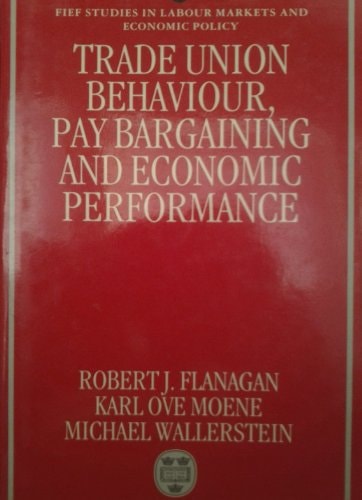
Trade Union Behaviour, Pay Bargaining and Economic Performance
0
0
As an Amazon Associate and affiliate partner, Menrva Books earns from qualifying purchases. Learn more
Author Description
The fourth volume in the FIEF Studies in Labour Markets and Economic Policy explores how trade unions formulate their policy and the effect of bargaining structures on economic performance. The first of the two papers presented in this volume uses collective choice analysis to examine the process of policy formation within unions. It argues that the political processes of unions are arranged to produce uniform preferences, thereby reducing the number of issues that are submitted to votes by union members. The second paper considers the centralization of bargaining procedures and the consequences of centralized bargaining on economic performance. A new model is presented that investigates the impact of different levels of union centralization on the trade off between wages and employment.
Menrva's Summary
THE THESIS
This volume investigates the internal political mechanisms of trade unions and the macroeconomic consequences of varying bargaining structures. The authors, Karl Ove Moene, Michael Wallerstein, and Robert J. Flanagan, utilize collective choice theory and economic modeling to analyze how union policy is formulated and how centralized wage bargaining impacts national economic performance. By examining the trade-off between wage levels and employment rates, the authors provide a framework for understanding the intersection of labor organization and economic outcomes.
THE SCOPE MAP
What You Will Find
- Analysis of collective choice processes within labor organizations
- Theoretical models regarding the centralization of wage bargaining procedures
- Examination of the trade-off between wage growth and employment levels
- Comparative study of bargaining structures and their influence on economic performance
THE AUTHORITY PERSPECTIVE
Experts identify this work as a significant contribution to the study of labor market institutions and collective bargaining theory. Readers frequently note the technical density of the economic models presented, making it a valuable resource for researchers and students of labor economics.
Page Count:
176
Publication Date:
1993-10-21
Publisher:
Oxford University Press
ISBN-10:
0198287984
ISBN-13:
9780198287988
Economics
Labor unions
Public Policy
Wages
Collective bargaining
Community Tags
Similar Books