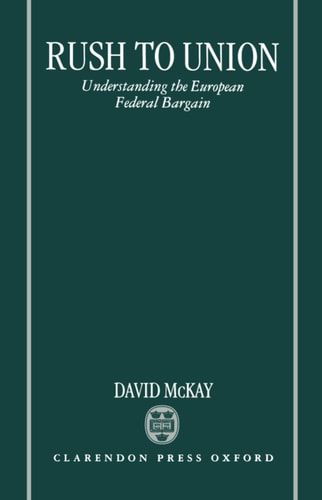
Rush to Union: Understanding the European Federal Bargain
0
0
As an Amazon Associate and affiliate partner, Menrva Books earns from qualifying purchases. Learn more
Author Description
The decision at Maastricht to create a political union and, in particular, to move towards a single currency, constitutes something of an intellectual puzzle. Why did the Europeans decide to create this union, and what are the chances of its succeeding? This book answers these questions by adapting William Riker's theory of federalism to the European case. It concludes that in the absence of fundamental political changes, European Union is not tenable.
Menrva's Summary
THE THESIS
This book investigates the political and economic motivations behind the European Union's decision to pursue a single currency and political integration. David McKay, a scholar of comparative politics, utilizes William Riker's federalist theory to analyze the structural viability of the European project. By applying this theoretical framework to the historical context of the Maastricht Treaty, the author evaluates whether the current institutional arrangements are sufficient to sustain a long-term federal union.
THE SCOPE MAP
What You Will Find
- Analysis of the Maastricht Treaty and its implications for European political union.
- Application of William Riker's theory of federalism to supranational governance.
- Evaluation of the economic and political prerequisites for a successful single currency.
- Critical assessment of the sustainability of the European Union without fundamental institutional reform.
THE AUTHORITY PERSPECTIVE
Experts recognize this work as a significant contribution to the study of European integration, particularly for its rigorous application of federalist theory to the EU. Readers frequently note the academic density of the prose, which serves as a foundational text for those examining the structural challenges of the Eurozone.
Page Count:
208
Publication Date:
1996-09-12
Publisher:
Clarendon Press
ISBN-10:
0198280580
ISBN-13:
9780198280583
Economics
Federalism
European federation
International relations
European Union
Community Tags
Similar Books