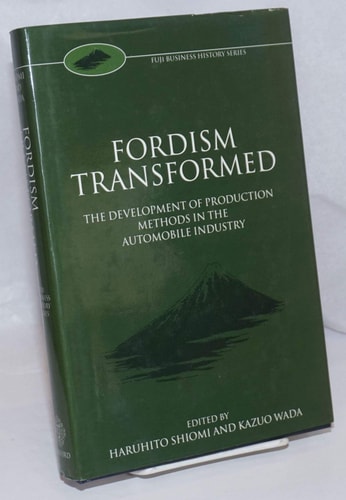
Fordism Transformed: The Development of Production Methods in the Automobile Industry
0
0
As an Amazon Associate and affiliate partner, Menrva Books earns from qualifying purchases. Learn more
Author Description
Written by leading Japanese, America, and European scholars. Based on proceedings of prestigious international conference. Japan is now the world's largest producer of cars but it only began to catch up with its competitors after World War II by studying and modifying the Ford system of mass production implemented first in the USA in the early part of the century. Other countries have also developed the system in their own ways with varying degrees of success. The papers in this volume will examine and compare the experiences of different countries in modifying the Ford system, and the impact of the `quality control movement' and lean production in Japan.
Menrva's Summary
THE THESIS
This volume investigates how the Fordist model of mass production was adapted, modified, and evolved across different national contexts to shape the modern global automobile industry. Edited by Haruhito Shiomi and Kazuo Wada, the text compiles research from an international assembly of scholars who analyze the transition from traditional Fordism to lean production systems. The work utilizes comparative historical data to evaluate how Japan, the United States, and European nations integrated quality control movements into their manufacturing frameworks.
THE SCOPE MAP
What You Will Find
- Comparative analysis of post-World War II automotive production strategies in Japan, the US, and Europe.
- Examination of the transition from mass production to lean manufacturing methodologies.
- Case studies detailing the implementation and impact of the quality control movement.
- Scholarly proceedings derived from an international conference on industrial development.
THE AUTHORITY PERSPECTIVE
Experts recognize this volume as a foundational academic resource for understanding the global diffusion of industrial production techniques. Scholars frequently cite the text for its rigorous comparative approach to the evolution of the automotive sector during the twentieth century.
Page Count:
336
Publication Date:
1996-02-29
Publisher:
Oxford University Press
ISBN-10:
0198289618
ISBN-13:
9780198289616
Business
History
Economics
Automotive
Production engineering
Automobile Industry And Trade
Manufacturing
Community Tags
Similar Books