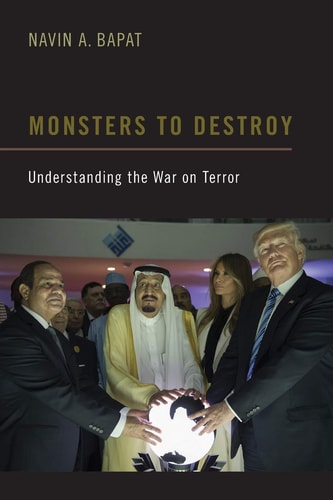
Monsters to Destroy: Understanding the War on Terror
0
0
As an Amazon Associate and affiliate partner, Menrva Books earns from qualifying purchases. Learn more
Author Description
Terrorism kills far fewer Americans annually than automobile accidents, firearms, or even lightning strikes. Given this minimal risk, why does the U.S. continue expending lives and treasure to fight the global war on terror? In Monsters to Destroy, Navin A. Bapat argues that the war on terror provides the U.S. a cover for its efforts to expand and preserve American control over global energy markets. To gain dominance over these markets, the U.S. offered protection to states critical in the extraction, sale, and transportation of energy from their "terrorist" internal and external enemies. However, since the U.S. was willing to protect these states in perpetuity, the leaders of these regimes had no incentive to disarm their terrorists. This inaction allowed terrorists to transition into more powerful and virulent insurgencies, leading the protected states to chart their own courses and ultimately break with U.S. foreign policy objectives. Bapat provides a sweeping look at how the loss of influence over these states has accelerated the decline of U.S. economic and military power, locking it into a permanent war for its own economic security.
Menrva's Summary
THE THESIS
This book investigates the strategic paradox of the U.S. global war on terror, questioning why the nation persists in high-cost military engagements despite the relatively low statistical threat posed by terrorism. Navin A. Bapat, a scholar of international relations and security, utilizes historical data and political theory to argue that the war on terror serves as a mechanism for maintaining U.S. hegemony over global energy markets. He posits that the U.S. strategy of providing security guarantees to energy-rich regimes created a moral hazard, where client states lacked the incentive to eliminate terrorist threats, ultimately undermining American influence and economic security.
THE SCOPE MAP
What You Will Find
- Analysis of U.S. foreign policy objectives regarding global energy markets.
- Examination of the security-for-protection trade-off between the U.S. and client regimes.
- Case studies of states involved in energy extraction, sale, and transportation.
Scope Limits
- The text does not provide a comprehensive history of all individual terrorist organizations.
- It does not focus on domestic counter-terrorism policies within the United States.
THE AUTHORITY PERSPECTIVE
Experts in international relations recognize this work as a critical examination of the intersection between security policy and economic interests. Readers frequently note the academic rigor of the prose and the clarity with which Bapat connects geopolitical strategy to long-term economic decline.
Page Count:
232
Publication Date:
2019-12-06
Publisher:
Oxford University Press
ISBN-10:
0190061464
ISBN-13:
9780190061463
Politics
World politics
Geopolitics
Intelligence
Politics & Government
Foreign Policy
New Used & Rental Textbooks
Specific Topics
International relations
Military History
Community Tags
Similar Books